


Andy Griffiths
The 10th Anniversary of Casting Iron at Coleg Sir Gâr
based on an edited transcript of a talk to CASW, October 2016
The Carmarthen School of Art (Coleg Sir Gâr) is one of the oldest art colleges in Britain: it was founded by public subscription in 1854. It has always had a reputation for ‘hands-on’ making and it is now the only college in Wales to offer a professional sculpture course at degree level. I have been there for 24 years. Initially I was a bronze caster, trained at the Central School of Art in London and taught by Henry Abercrombie (Ab); I then went on to work for 7 years with Ab and Andy Elton at AA Fine Art Foundry (now AB Fine Art). This involved casting and working alongside some very well known sculptors, such as Bill Woodrow and Bill Turnbull and I became the personal assistant to Barry Flanagan and AR Penk. I then returned to Wales in 1994 to work at Carmarthen and found myself with a bronze foundry designed 18 years earlier by Abercrombie, and so I felt very ‘at home’ and happy.
There were four people who influenced the move into iron casting at the college: Robert Harding, a lecturer with me in Carmarthen who ‘led me down the iron path’; Matthew Tomalin with whom I first cast iron and is known to all and sundry as the ‘Master Blaster’ because he knows everything about iron; Harvey Hood who operates from Berllanderi near Raglan where I did my first ‘group pour’; and Coral Lambert from the USA who convinced me that students could do this safely.
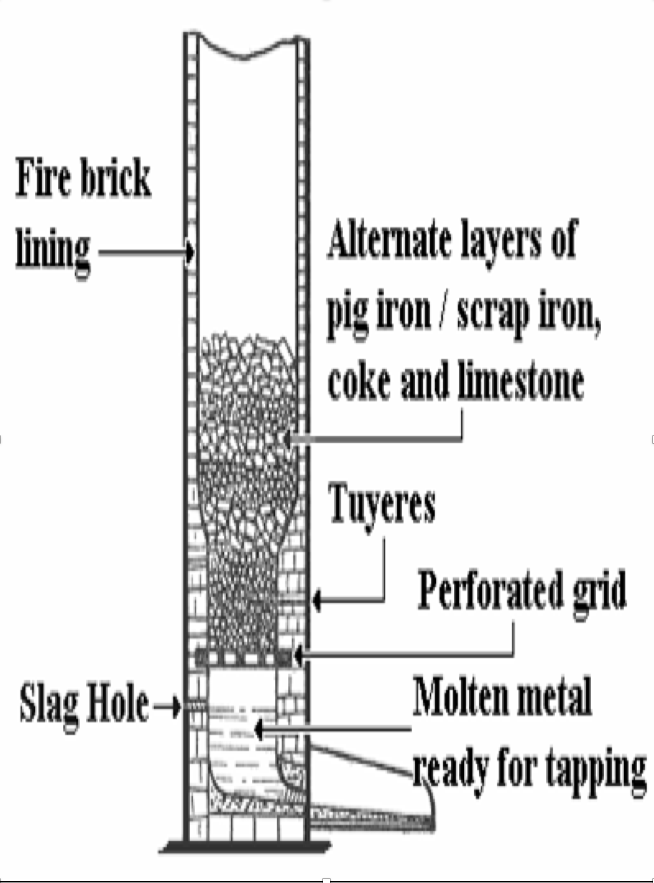
This is a very old illustration of a cupola furnace. This is how we make iron. We have a stack made in steel and lined with refractory material (in this case fire bricks). We put in coke, limestone and iron in a repeated layered ‘club sandwich’ to the top. We apply heat to light the coke and through the tuyeres we pump air, and that blast raises the temperature enough to melt iron. It gathers in the bottom and we tap it out. In contrast, to melt bronze you just flick a switch, wait an hour or so for it to go liquid, and then pour it! Iron has this incredible ballet about it; you have to feed it, poke it, remove the slag as it builds up and generally look after it because it can go horribly wrong very quickly and freeze, and that is it – days of work wasted and more days of work to break out the lump and repair the damage. For me it is an alchemical process – we smash rubbish iron to put in the top (old broken baths, radiators, gutters etc) and out comes liquid ‘gold’ at the bottom – it is amazing.
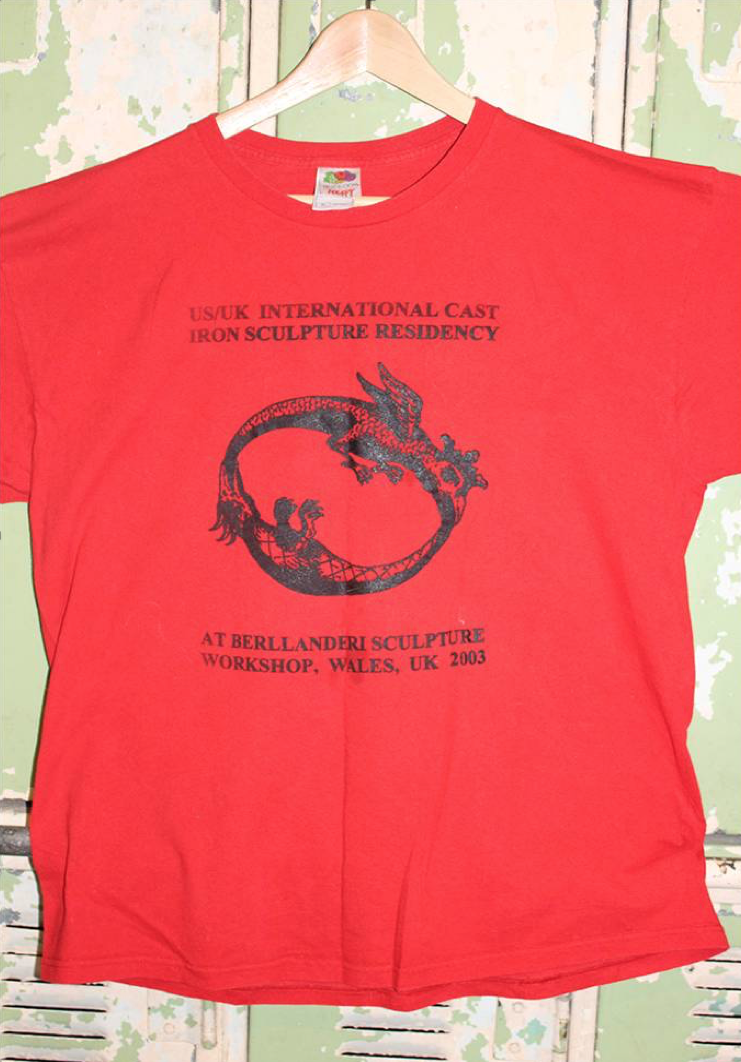
This is a tee shirt that marks the start of when I started pouring iron in 2003, and these commemorative tee shirts are almost invariably produced to mark significant iron events. They are a bit like karate belts i.e. worn with pride till they almost wear out. The Black Belt can become almost white with age – this being a sign of great experience and expertise; the tee shirt on the other hand accumulates spark holes, unmentionable stains and after numerous washes the lettering starts to fade but is part of the pedigree of iron casters. This tee shirt commemorates the US/UK event organised by Coral Lambert at Harvey Hood’s studio which was my first experience of an intensive week-long group mould-making symposium and iron pour. Prior to this I had helped Matthew Tomalin at Caerau Farm, near Brecon, with a few pours, but such events were over in a day. In Brecon I could see the possibility of doing this myself on a professional basis within my own studio but thought it too complicated and dangerous for students. It was with Harvey and Coral that I realised its potential within college. Coral is a ‘wild child’ with a ‘suck it and see’ approach, and she told me about the network of colleges in the USA that have developed iron casting as an integral part of their sculpture syllabi. Coral was starting to organise the 5th International Conference on Contemporary Cast Iron Art, scheduled to take place in 2006 at Ironbridge, and suggested that the College build a furnace and attend. So, when term started again, I put this idea to both the students and ‘senior management’. The students were enthusiastic but management needed more persuading. The ‘powers that be’ could see the publicity potential but insisted that the equipment was made outside timetabled time and, as they were not willing to commit extra resources to this ‘risky’ development, it was necessary to do it as cheaply as possible.
A few weeks prior to the Ironbridge event we had a practice run with students at Tondu Iron Works, near Bridgend. Dilys Jackson, who then worked for the Groundworks Trust, had arranged for Harvey Hood’s furnace to have a permanent home at this historic site. Coral was again over in the UK and supervised us in a hardhat version of a Stetson! Luckily it was a success and the students returned to College with renewed enthusiasm to finish our own furnace.
We finished building our first furnace, christened Y Ddraig Goch (there is a tradition among iron casters of giving names to furnaces), only a week before the International Conference started. We had followed a small drawing that Matthew provided, but none of us really knew what we were doing. For the students to witness their lecturers just as flummoxed as they were was an educational experience worth its weight in gold as they really began to understand that ‘problem solving’ is a proper skill. Initially we could not get the furnace to run properly as we had not balanced the blast to the diameter of the tuyeres; it was literally the day before travelling to the conference that we eventually got hot melted iron.
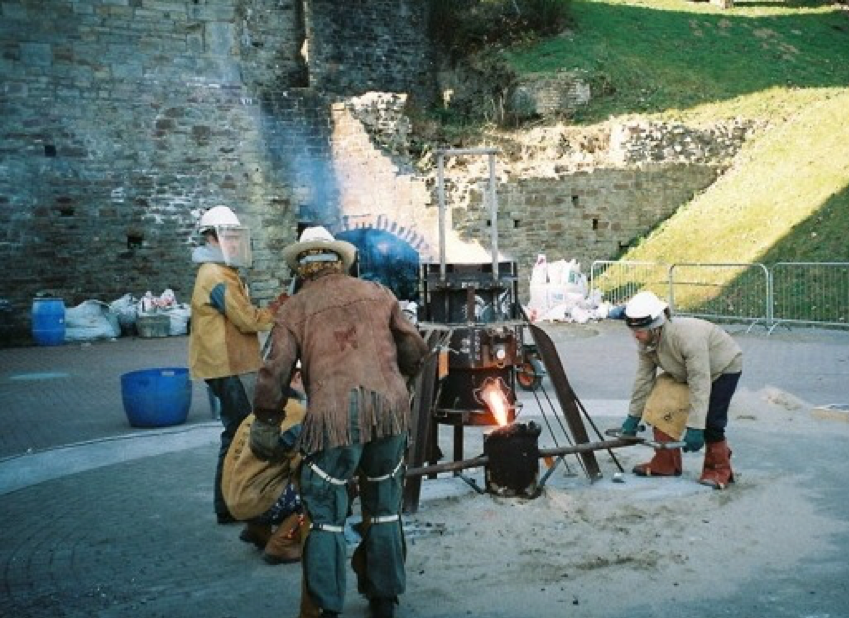
Pouring iron at Tondu Iron Works 2006
One of our students, Tom Fabian, had built a yurt for us to live in as the others slaved away during the winter evenings in the metalshop. So we arrived in glorious April sunshine and set up camp full of the joys of spring. Then we proceeded into the town of Ironbridge to establish our base on the ‘casting field’. This turned out to be the muddy end of Aga Rayburn’s back yard with the black gunk of 200 years of iron casting. As we had arrived last and were the ‘newbies’, we were allocated the end of the row of furnaces in the wettest part of the yard – a grim start.
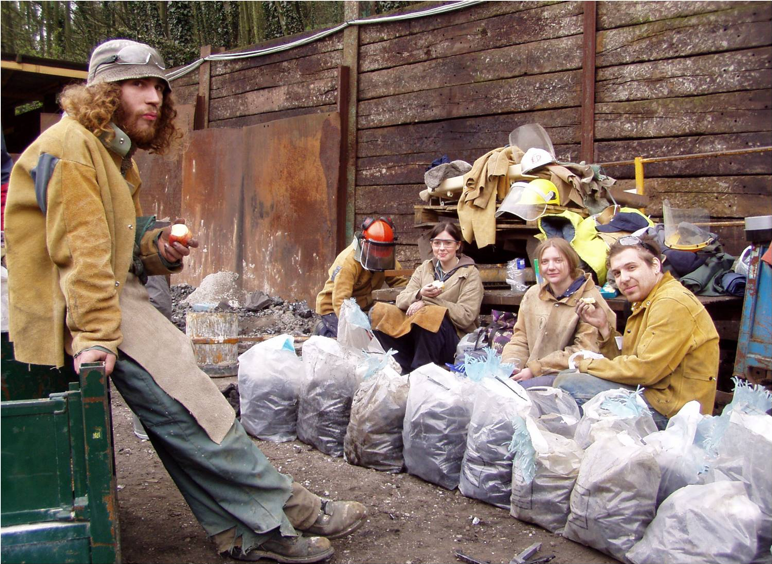
This was part of my lovely student team taking a break from setting up and having some well earned food. Moments later they were told by Matthew (in the red helmet) that they had broken up the coke into the wrong sizes and therefore had to tip it all out and start preparing the charges all over again and throughout it all they never complained once. They just sat in the mud and smashed iron and coke – they were brilliant.
So this was the casting field with 5 other furnaces and the whole of the international iron casting community watching us, or at least about 200 of them. I had lined the furnace with some old refractory material that I had found in a dusty corner of a College storeroom whose only discernible part of the label read ‘Hot’. By the end of the day that is what it was, and indeed great chunks of it had melted away into the iron instead of becoming vitrified – one of the problems of doing this development on a ‘shoestring’. However, other more experienced teams also had problems, so in the end only two furnaces ran all day and into the night – ours and a tall furnace (a continuous tapper about which more later that you can see behind us in the picture below) which was built in Oxford by two American Professors.
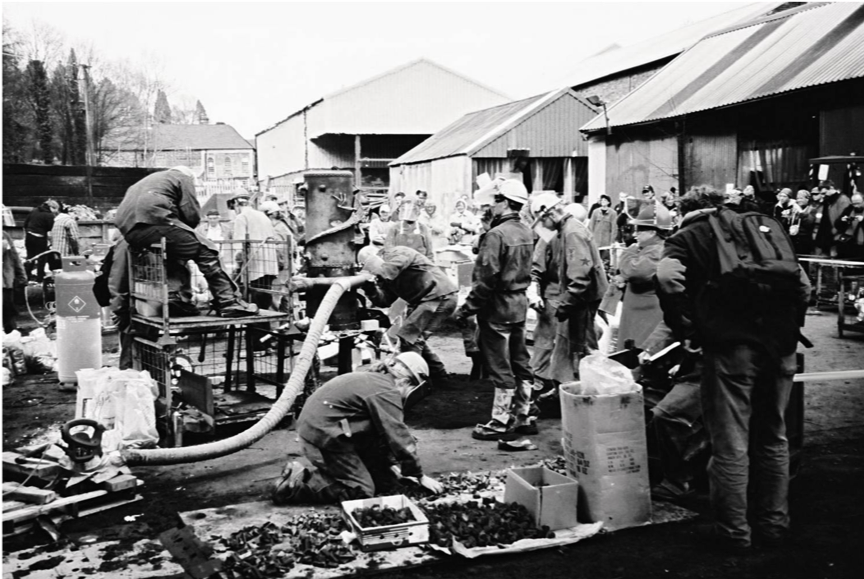
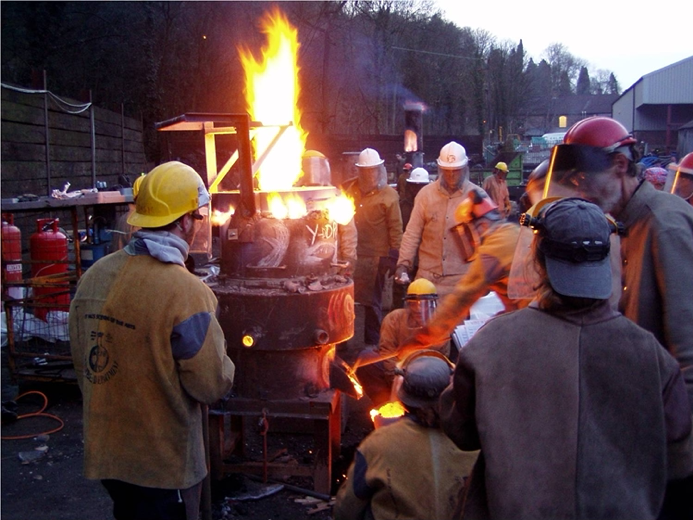
Between us we must have cast about 2 tons and filled all the moulds – we were celebrated as heroes. It then cost me £150 in the Bar: it might have been a lot more if we hadn’t finished pouring so near ‘closing time’ but I would have paid twice that amount for the experience of the day.
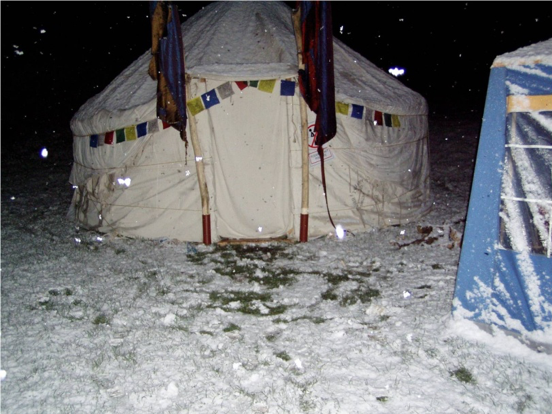
Next morning, all hungover, we woke up to snow!
Ironbridge was also the first time we witnessed the potential of iron, not only to fill lots of different types of mould but also to be used as part of a performance/ritual. Such performances where great quantities of molten metal are used could not be done with expensive materials like aluminium or bronze. This realisation had a profound impact on a number of the students, so when we returned to College we decided to institute a regular public performance event around the Autumn break to coincide with the ‘Day of the Dead’/Halloween. https://www.youtube.com/watch?v=KL7TsHYMhMM
This public event has been running annually for 10 years. It is important to us that people come and see these hot processes: bronze pours at about 900C and iron at about 1500C. We are the only college in Britain that casts at such temperatures.
After our success at Ironbridge we were now on an international stage. The team from Carmarthen had met people from Georgia, New York, New Mexico, Seattle, Belgium, China etc. and been accepted into the ‘community’. It was all a bit amazing. At the end of the conference, Coral took me aside and said that the consensus among the community was that, because of the enthusiasm of our small band of students, we should organise the next conference! I prevaricated; we are so small and we do not get research funding like large university departments. But I realised that the whole world had suddenly opened up to us – if I had stuck to bronze casting none of this would have happened.
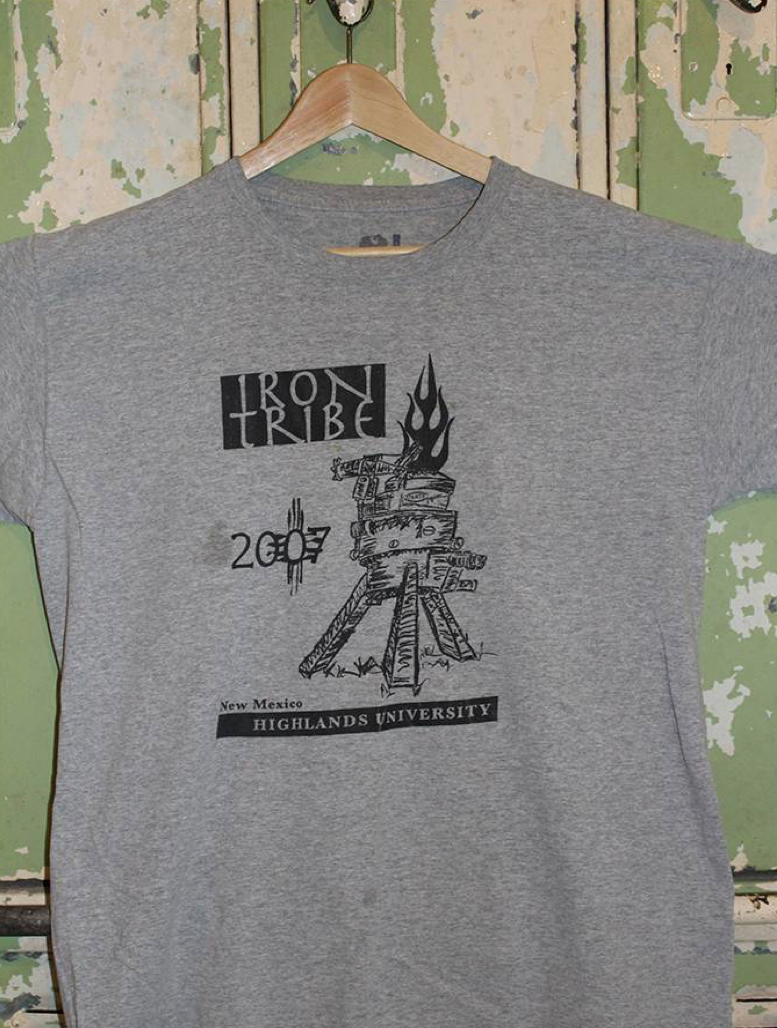
The following year in 2007 we were invited to go to the Iron Tribe event in New Mexico a mile above sea level. Six or seven of us went on this adventure. Despite hardly being able to breathe, our kudos grew as we were the only college there from outside continental America. Three weeks later two of our students, Steve and Liz, returned to another part of the USA for another iron event.
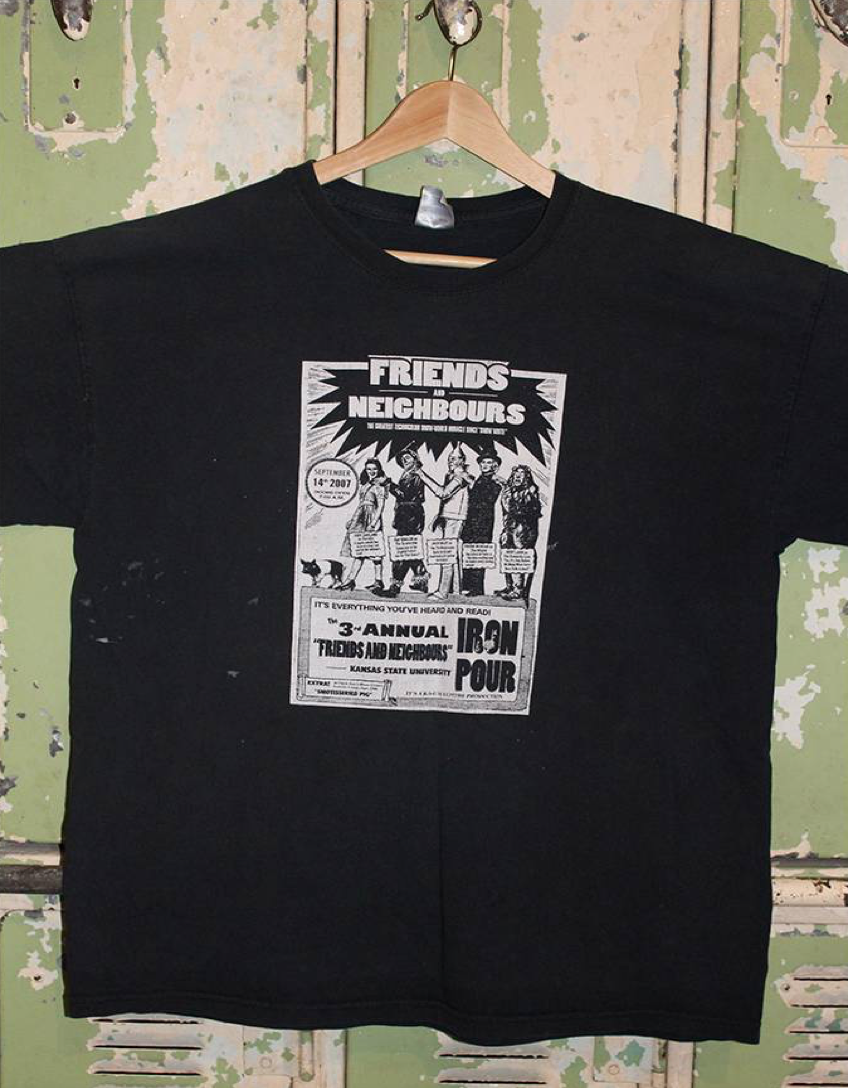
Then we were invited to Kansas to an event billed as Friends & Neighbours; there we were hosted by Dan Hunt, the Professor of Sculpture at Kansas State University, who had to remove 16 guns from my bed before I could sleep!
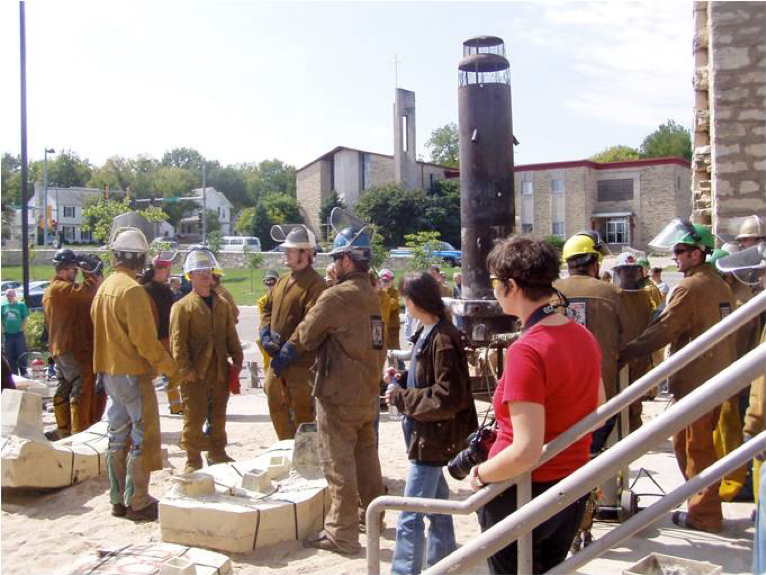
This photograph was taken in Kansas at 6am, as it got too hot to work by midday. So iron was poured early and then a dumper truck arrived and swept up the burnt coke, the slag and the remnants of sand moulds – in Carmarthen we just have two shovels and a wheel barrow! This tall furnace was built and run by Casey Westbrook, who more recently has designed, built and supervised the 5 furnaces in Matthew Barney’s epic 320 minute film River of Fundament (2014) that simultaneously poured 5 tons each to create a 25 ton river of molten metal down a hill and into a Thunderbird mould. We were now mixing with iron maestros! It was here that I started to create a sculpture – Elvis’s Car – that would take the next ten years to complete to my satisfaction. It is based on the whole ‘Americana’ experience that I was suddenly becoming immersed in. Later incarnations of this piece will emerge towards the end of this talk.
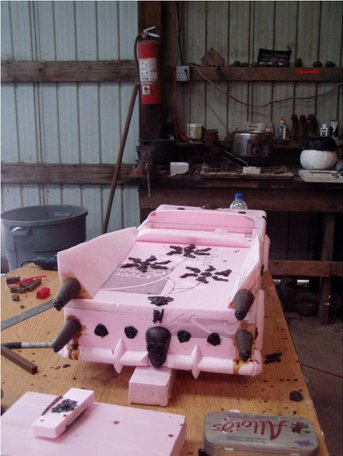
Elvis’s Car in 2007
Whilst in Kansas we set up an exchange so that two American students could come to Carmarthen for a semester and two Welsh students could go to the cowboy state of Kansas: this was on the basis of a straight swap of accommodation and fees, and so by keeping it simple, it worked for a number of years.
We had witnessed in Kansas their large continuous tapping cupola pour 6000lbs of iron in 3 hours, but with Draig Goch we only get about 400lbs an hour, so we thought that increasing our pour rate might improve our productivity. Working with Kansas students we built a continuous tapping cupola on an American design. In respect of its US credentials we christened it ‘Jack the Dripper’, but unfortunately it didn’t perform quite as well as its namesake (Jackson Pollock) and like him it had an untimely demise, but various parts have been cannibalised into other and more reliable Welsh furnaces.
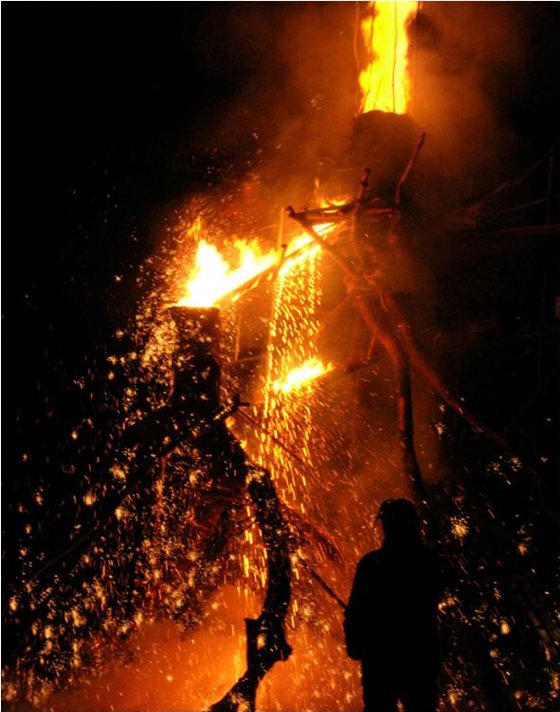
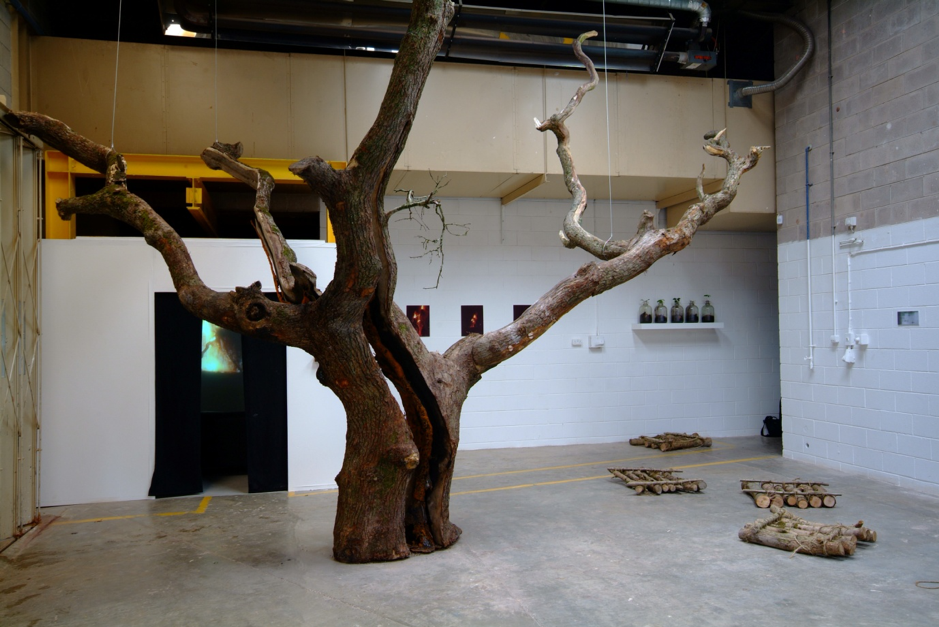
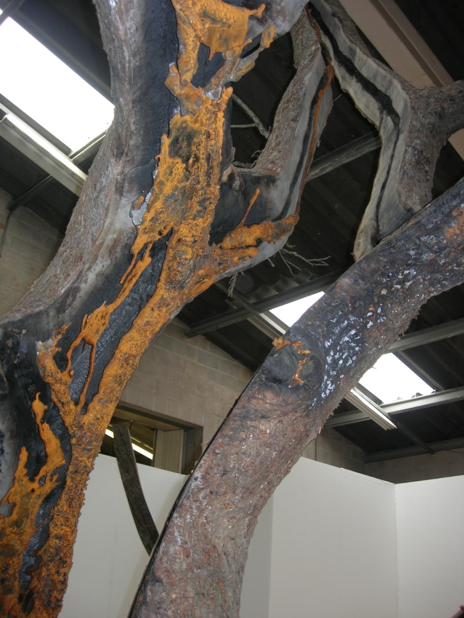
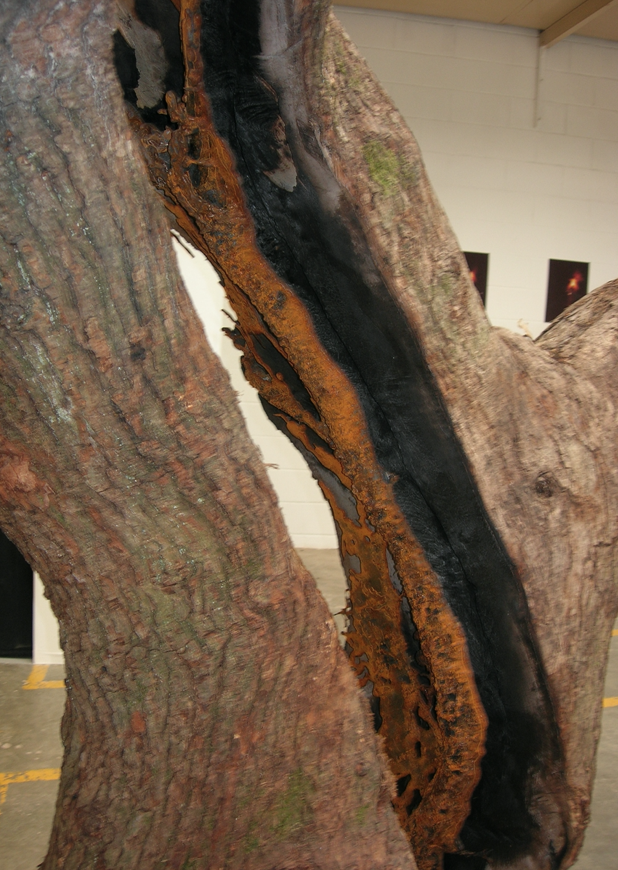
Tom Fabian, one of our sculpture students in Carmarthen, had witnessed a ‘performance pour’ at Ironbridge, and so, when he came to his final year, he was determined to try something similar. After consultation and a few small experimental pieces using wood, he chose to pour iron into an upturned eighteen foot hollow tree trunk at the summer equinox.
The furnace was built on a higher scaffolding tower and was made from some of the small branches from the tree woven together and lined with ‘baked mud’. Before the furnace consumed itself a charge of iron was melted and fed into the tree. A film was made of the event and subsequently the tree and edited film were exhibited at Carmarthen College along with some other pieces.
He achieved the best marks we have ever given a degree student.
Our next trip abroad was to Birmingham, Alabama in 2009, for the large American National Conference where we met up with some of the students from Kansas. We were a small group of 8 among a crowd of 600 or so delegates, many of whom arrived in large trucks complete with all their furnaces, pour gear etc. This conference is held every two years at the Sloss Historical Ironworks and it is awe inspiring to wander through this vast factory museum. The event is geared to encouraging students to work with molten iron, and there are prizes for the hottest metal, the quickest metal, the most original furnace design etc.
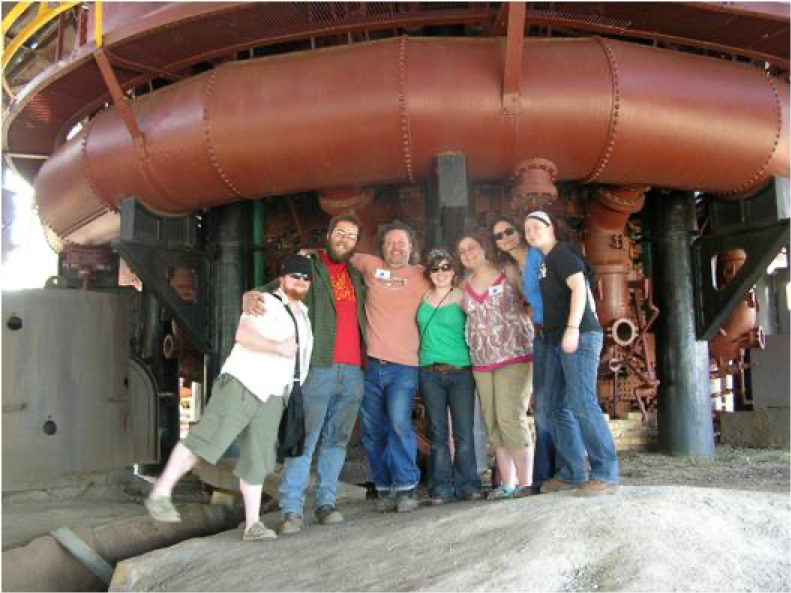
So this was part of my team (posing under a giant wind belt) and their subsequent careers all testify to the influence of this process: from left to right Chris (who currently works at AB Fine Art in London but is about to emigrate to California where he plans to set up a foundry), Steve (who has set up a foundry in Dorset having done an MFA in America), a younger version of me, Patrice (in green who now works at Pangolin in Stroud), Trish (who now works at Red Bronze in London) Justine (who although she graduated a number of years before we started iron, attended the Ironbridge event and has made many new contacts through subsequent iron events in the UK and USA; however, she is more elegant than the rest of us and played a CIA agent in the latest Bourne film), and Jasmine (who met someone from Ohio and is now married and living over there).
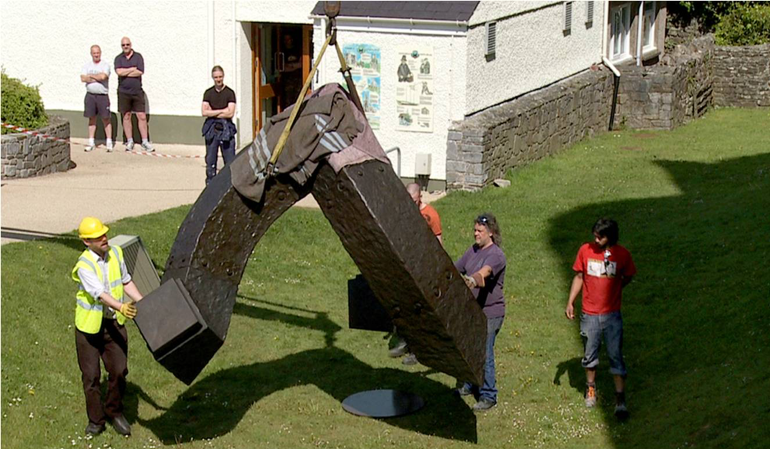
It was in Alabama that I agreed to organise the 6th International Conference in Wales in 2010. I had considered going back to Ironbridge because Aga Raeburn and the Steel Sculpture Museum had been great hosts in 2006, but it would have involved a lot of commuting. I lived in Kidwelly at the time and it seemed appropriate to base it near home. Not only would the logistics be easier, near to College, but my local contacts could be supplemented by a core of reliable colleagues, to whom I could delegate various jobs and responsibilities. Kidwelly has two great attractions – the fantastic castle and the old iron and tinplate works – plus it is close enough to Blaenavon to run a coach trip for delegates. The industrial museum was very willing to host the conference even after they had seen images of mad sculptors throwing iron about! With the support of CADW, Gibbs Trust, ACW, Morel Trust, CASW and Sculpture Cymru, we also organised an international exhibition of iron sculpture in the Castle selected by Wilfred Cass (Goodwood). The next image is the installation at the Castle Gate of a 3.5 ton iron sculpture by Charles Hadcock being undertaken by myself and three students (one from Finland) – another great educational experience.
Also illustrated below, two other pieces from the Ironstone exhibition that had 14 pieces of sculpture in total.
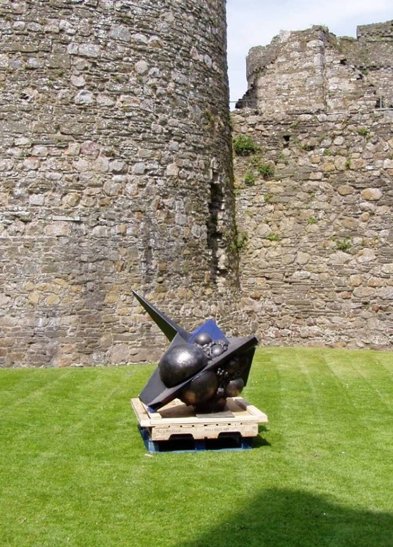
The Cloud of Unknowing by Coral Lambert
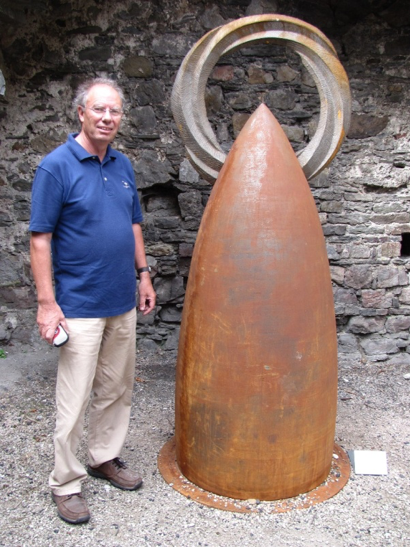
Cast Iron Quasar by Harvey Hood
The conference itself attracted over 180 delegates which considering the economic uncertainty of the time was heartening. Not only did we make a small profit that went on to the next International Conference in 2014 in Latvia, but it was also good for the other businesses in town such as the B&Bs. The Rugby Club, which hosted the camping delegates, made so much in the bar that they could afford to refurbish the whole place!
At the conference itself, I was determined that both the first furnace lit and the first iron poured would be Welsh. So on the opening night we poured 300lb of iron into a vast sand mould of a fish and seaweed encased in a car: this event choreographed by Tamsin Ringler is an example of the sort of projects proposed at these conferences that stretch an individual’s usual artistic practice.
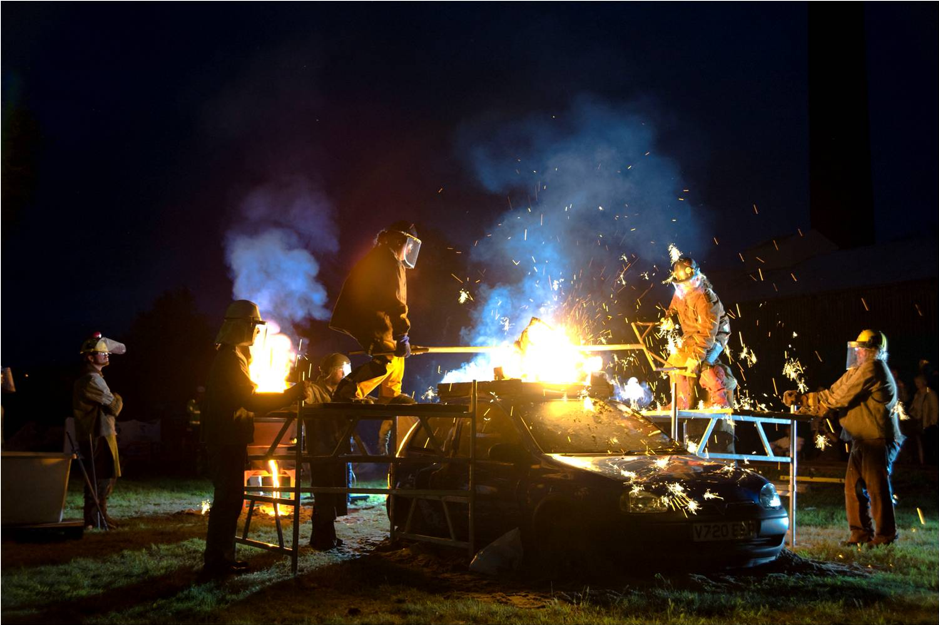
We lit our furnace four times during the conference for various performances. But such conferences are not just about ‘making or doing’: there are also lectures, discussion panels, exhibitions and demonstrations. We had become an integral part of the international cast iron community. https://www.youtube.com/watch?v=rUnABgFRnsM
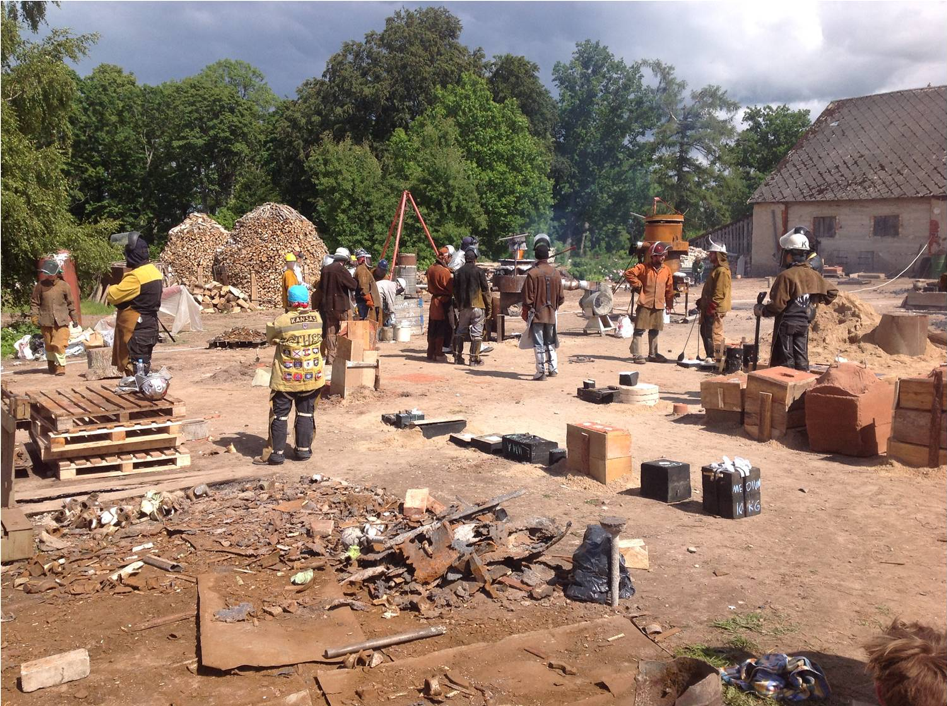
After 2010, I taught an annual session at the Royal College of Art. I did this for 4 years until I persuaded their foundry technician, Irene Gunston, to move her base to Wales and teach with me at Carmarthen! We have helped friends in Cork at the Sculpture Factory and Crawford College of Art in 2012 and 2014 to facilitate iron casting events in Ireland – it is wonderful to witness our students teaching others who have never made a sand mould, never run a furnace and never poured a line of moulds. Our students now feel confident enough to go out to America by themselves and have participated in various iron related events all over the USA. One pair, Jeff (from Ireland) and Emily (from Pembrokeshire) built a furnace from scratch in two weeks and won the ‘first metal’, ‘hottest metal’ and ‘best cupola’ at the 2011 National conference at Sloss – they have since married! Matthew and I were invited out to Arizona to teach American students: surrounded by cacti we worked outside the whole time as it only rains on one day a year – a great change from Carmarthen! We also participated in the 2014 7th International Conference in Latvia (see image below) that seems to be even colder and wetter than Carmarthen.
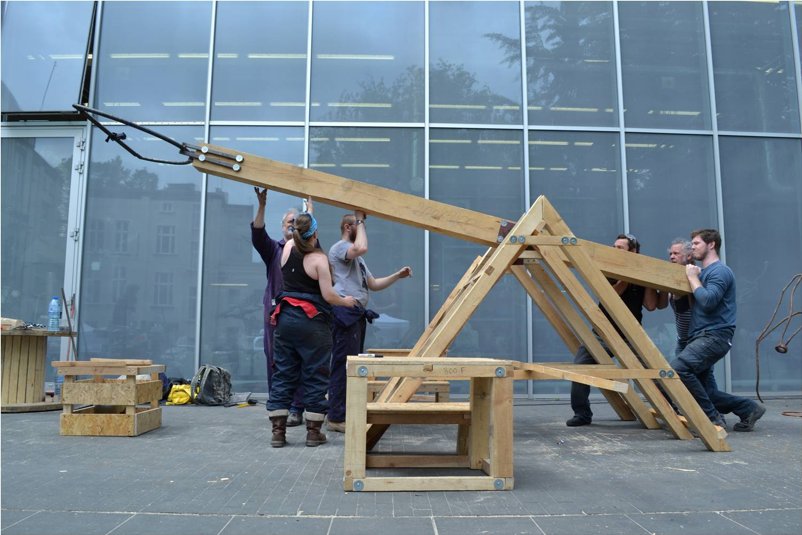
In 2015 I was invited to go to the High Temperature Arts Festival in Wroclaw, Poland. A month before the visit, I was asked what my ‘performance’ was going to be called so that it could be included in the programme. I had thought that I was just going out there to make a moulded iron sculpture. Panic. However, having witnessed such performances over these past ten years I knew what worked visually, so requested that I go out with my colleague Robert Harding and my then student team of 5 people. I devised a trebuchet type structure which would both act as a runner/channel for the open-faced mould and as a pivot to raise the piece into the air.
The event was to take place at the mid summer solstice, so I planned to raise a ‘new sun’ into the darkening Polish sky. All went according to plan until I got over excited and started the lift about a minute too early as the iron hadn’t quite solidified enough around the embedded steel armature. What rose was a phoenix, not a sun.
However, I must have done something right as I was invited back this year and determined a slightly less risky strategy should be adopted; rather than raising 180lb of red hot iron above our heads, we would do this in small component parts. This time my proposed sculptural performance was based on the southern hemisphere constellation ‘The Sculptor’. This is situated near the Southern Galactic Pole and is right next to ‘The Phoenix’ constellation! Each of the sculpted stars were raised into the air whilst still red hot on their individual bars.
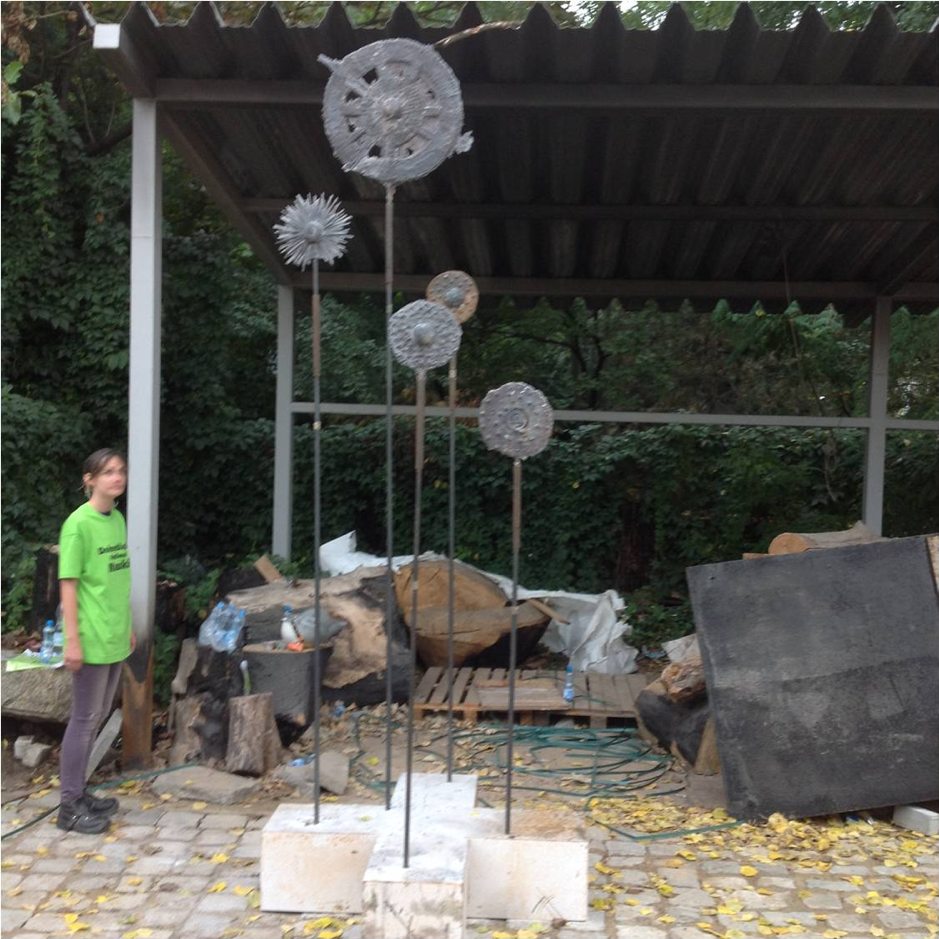
Preparing The Sculptor – after casting, but before installation
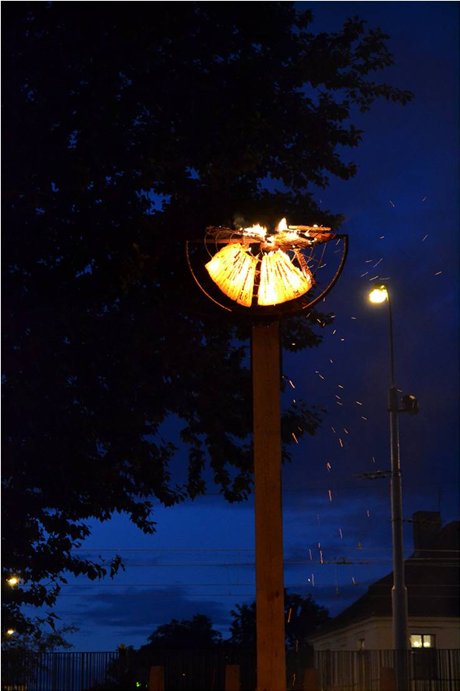
The work is now installed in the Wroclaw Art Academy sculpture garden. In just under two weeks time Michal Staszczak and two of his students from Wroclaw are coming to Wales to celebrate our annual Day of the Dead event and participate in our tenth anniversary celebrations in Carmarthen.
I am aware that I have shown you lots of images of ‘process’ and not so much ‘product’. This is partly because iron casting is particularly photogenic but also because the images capture some of the ‘danger’ and camaraderie that so appeals to students. So, to conclude I will show you the development of one particular piece.
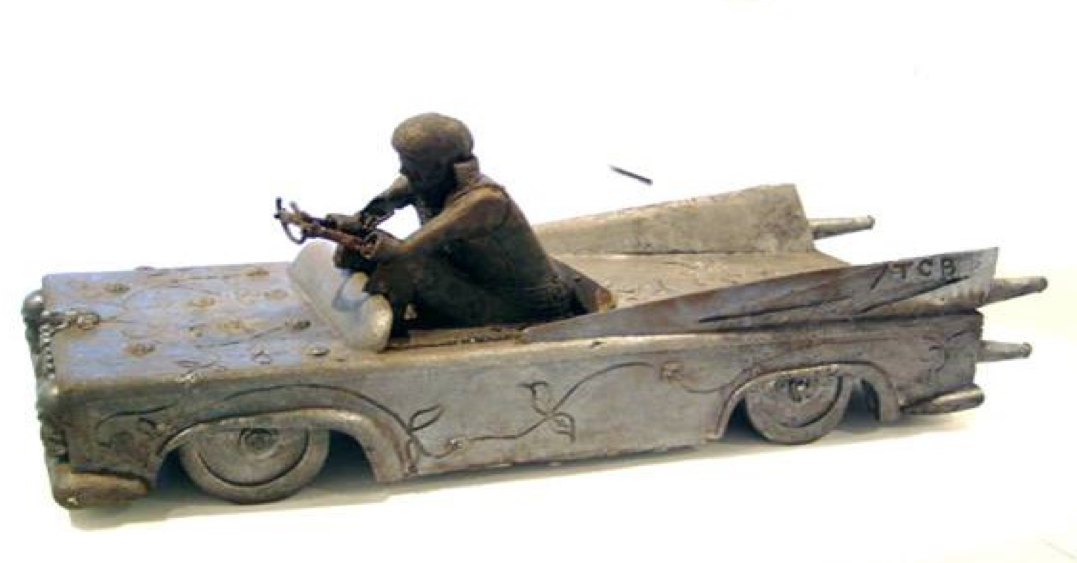
Earlier I showed you an image of my first attempt in 2007 at synthesising all the American aesthetic that I have been exposed to alongside cast iron. Elvis’s Car was cast in Kansas in 2009.
Later in Wales I made a figurine of Elvis, and changed the name of the piece to Dead Elvis’s Car – but I was not happy with the result. It sat under a bench in the metal workshop at College for a number of years.
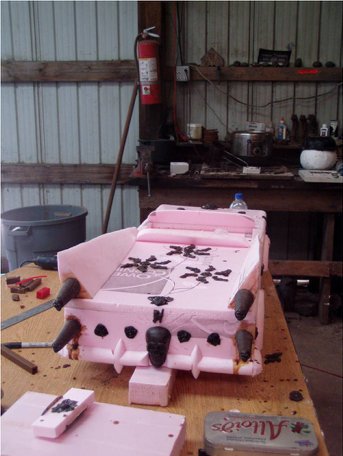
I then saw the Bronze Exhibition in 2012 at The Royal Academy of Art, and was blown away by the Cult Chariot of the Sun from Seeland (14th century BCE) and the Chariot of Stettweg from Hallstadt (7th century BCE) – both Celtic artefacts.
The next step was to ‘big up’ the original wheels of Dead Elvis’s Car, which I did in my first ‘stack mould’ in 2013 in Carmarthen.
The horse was cast in Devon during the summer of 2013 whilst introducing the joys of DIY iron casting to Peter Randall Page. The ‘My Little Ponies’ were cast last year in Poland and the Sun record (Elvis’s legendary record label) came from eBay. So the car has now metamorphosed into a contemporary Cult Chariot of the Sun which sums up my journey through iron casting, all over the world, over the last ten years.
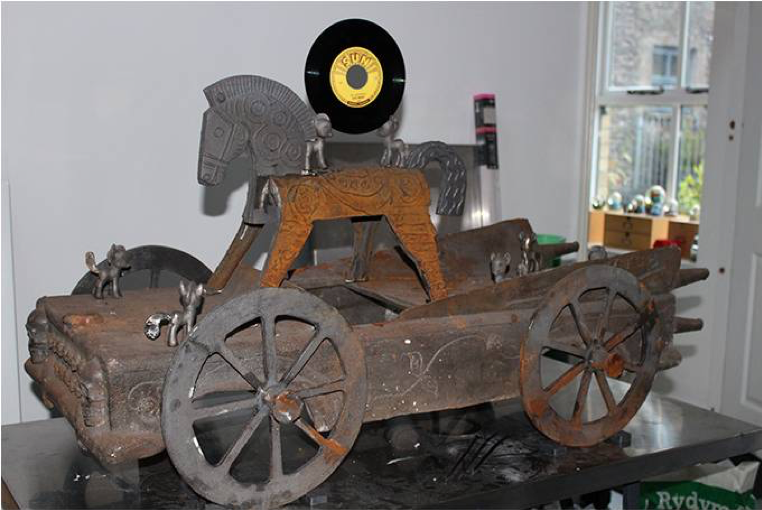
Cult Chariot of the Sun 2016 Andy Griffiths
Note about the contributor
Andy Griffiths was born in Wallasey in 1956 and came to Wales in 1959. He did his Foundation Art at Wrexham (1974-5) but then became involved with Punk Rock. He was the lead singer of The Wall from 1978 to 1983. Then he returned to art at The Central School of Art in London where he graduated in 1987. He is now Head of Sculpture at Carmarthen School of Art (Coleg Sir Gâr).
© the artist