


The Abject Artist: Exploring the Capacity of Art to Communicate the Experience of Illness
Based on a talk to CASW, November 2016
For want of awareness – For want of openness – For want of a shared experience
As a visual artist and writer I feel that at the very beginning I should point out that being an artist is not so much what I do, as what I am – I have no choice about that! Creative practice is integral to how I understand myself. Creativity is, for me, a visceral thing.
I refuse any limitations imposed by a firm dialectic between practice and theory. Indeed, following French philosopher Gilles Deleuze I embrace rhizomic interrelation and this is grounded in my passion for an ongoing enquiry into what Heidegger calls ‘dasein’, or how we engage as individuals within the perceived reality of our world, and with others in it. I believe in empathy over sympathy, and in the importance of the subjective.
The Drawing Women’s Cancer project began my involvement as an artist in medicine. It was originally inspired by a question asked me by a surgeon while we were talking about gynaecological disease in particular. She asked, ‘But can you draw what it feels like, rather than what it looks like?’ The project was the beginning of wider work in the medical area and the methodology that I began to develop through the project has generated several further projects, all of which are interrelated and all of which involve me crossing the boundary between health and ill health. I am a regular visitor then to the world that Sontag describes as the ‘Kingdom of the Sick’, even though at least for the present, I have the fortune to retain my own health in the ‘Kingdom of the Well’, and having spent a lot of time in the Kingdom of the Sick, listening to and often building ongoing relationships with people suffering illness, I have immersed myself in their medical lives and in the stories they tell of their overall experiences.
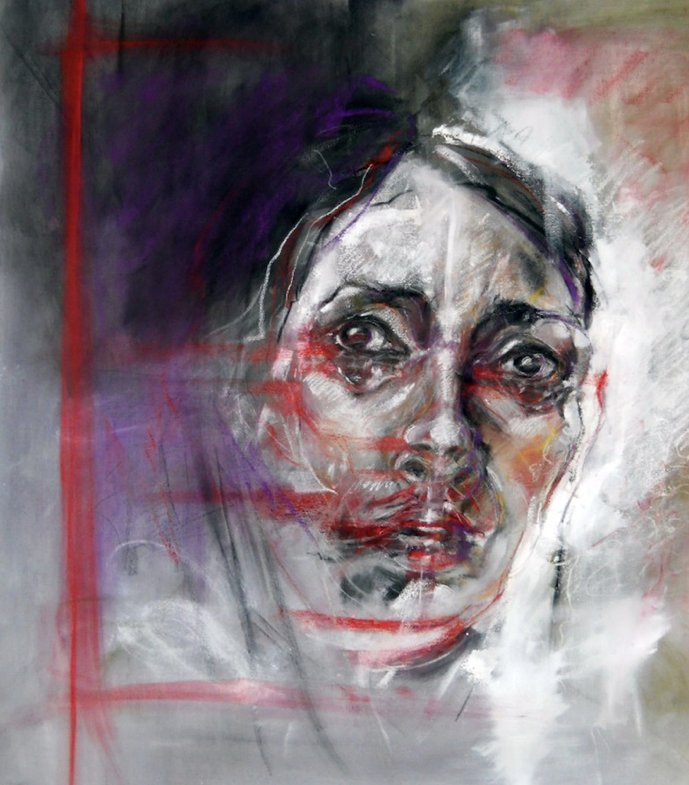
Diagnosis
Through my creative work I respond not in a detached way that attempts perhaps to illustrate their stories – I feel that this could only ever be a superficial way of working and in many ways almost disrespectful. I respond rather to ‘my own experience of their experience’ and through this I have come to understand in a very profound way Sontag’s insistence that in fact we all hold dual citizenship, a passport to either side of the health/ill-health divide.
I have also come to understand and appreciate more profoundly another place, a place in between, a ‘liminal space’ wherein the extremes of health and ill-health give way to overall experience. This is the place where objectivity and subjectivity collide and commune, where mediation affords meaning the opportunity to take on a new persona, and where the overall impact of illness cannot be reduced to a clinical conception of disease.
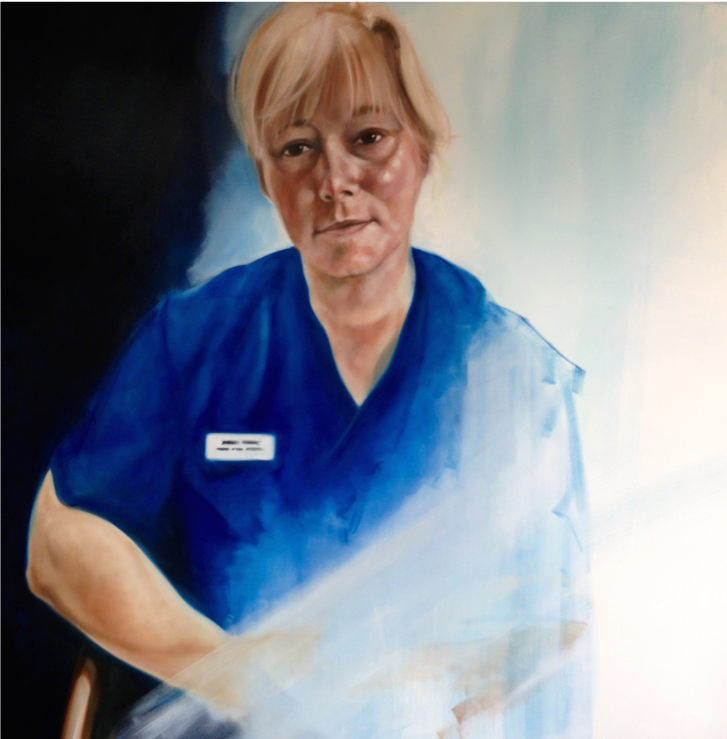
GU Specialist Breast Nurse
When we become sick we often become disorientated within our social milieu. Our accustomed way of being, our relationship with what is deemed normal, changes. Sometimes it happens suddenly and dramatically, sometimes it is slow and insidious, but either way for me as an artist, and a human being, the exploration of this disorientation and the attempt to articulate it, to give it a ‘voice’, provides the basis for what I believe can be a legitimate and productive relationship between art and 21st century biomedical science. Art, free from the shackles of servitude in the face of the rise of science, can independently reinstate the subjective into medicine, the sensitivity and humanity that the need for objectivity can sometimes mitigate.
Of course medical treatment, by necessity, must embrace objectivity. But the clinical detachment that allows the health professional to treat the patient’s condition efficiently can serve to ensure that the illness experience overall is of secondary importance to the control of the actual disease, because scientific efficiency, and indeed efficacy, does not in itself entail empathy.
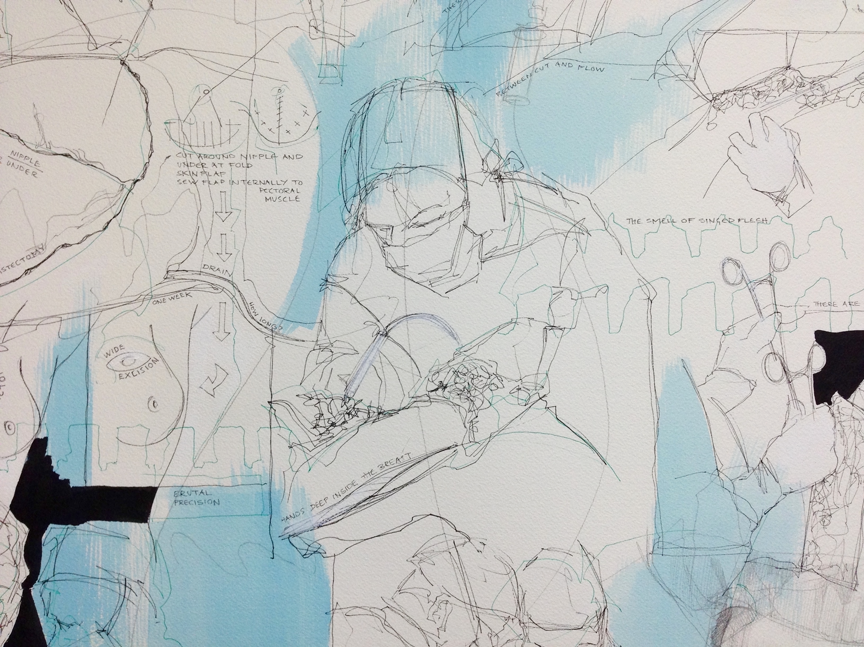
In Theatre (detail)
Clinical detachment – Foucault’s ‘medical gaze’ – is a general and pervasive phenomenon. It is not limited to any particular society or culture, as my comparative experiences of working with both patients and health professionals in the UK, in the US and in Tanzania can testify. The science that such detachment is grounded upon however can never be an end in itself. It is rather something that medicine in general must draw on. As a practice, medicine, like art practice, can embody both objectivity and subjectivity in varying degrees. This has been especially obvious in many of the individual doctor-patient relationships that I have witnessed, where objective science cannot and does not evade the experiences of the ‘person behind the diagnosis’ and there is a tacit requirement that individual experience remain meaningful.
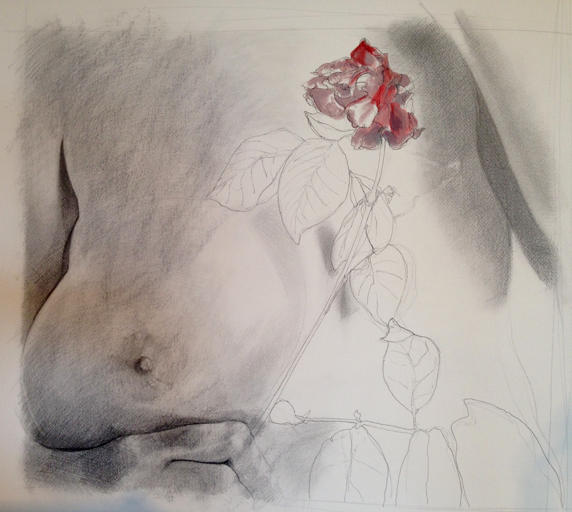
Loss
For the most part meaning is communicated here through language, but still there is a problem because language in the conventional sense is of course the agent of both the medical ‘case history’, and of the stories patients tell, their personal narratives of their illness as lived. The difference between these two forms of communication can be crudely characterised as that between the objectivity and subjectivity wherein the role of empathy is marginalised, but meaning arises not from things in isolation but rather from the interactions and interrelations and, as in any relationship, it is the ‘in-betweenness’, the ‘liminal space’ I mentioned earlier, where true significance can grow. As an artist, it is within this space that I can begin work that focuses on the existential lived experience of illness – the overall impact that becoming sick has on individual lives, both of the sick person themselves and on those that care for them. For me, this is the best and most productive way to be an artist in medicine in today’s society.
My work as a whole has evolved then into an interdisciplinary exploration of the capacity of visual art, as a form of language in itself and in symbiotic relation with conventional dialogue, to coincide with medicine beyond socio-historical, cultural and philosophical limitations, to express and profoundly articulate the lived experience of illness. All of the projects I am working on are profoundly interconnected through the focus on lived experience and through a methodological approach that I have been developing throughout for which I use the provisional title of The Abject Artist.
The concept of the abject artist derives from, and indeed requires, an autoethnographic approach that I have adopted since the start of Drawing Women’s Cancer in 2012. I believe that an ‘autoethnographic stance’ is not just the most productive approach but is also the most credible because where medicine posits a distanced observer who observes the cultural other and postulates objective truths, autoethnography breaks barriers between observer and observed, self and other, by conflating all into one person, in this case, myself.
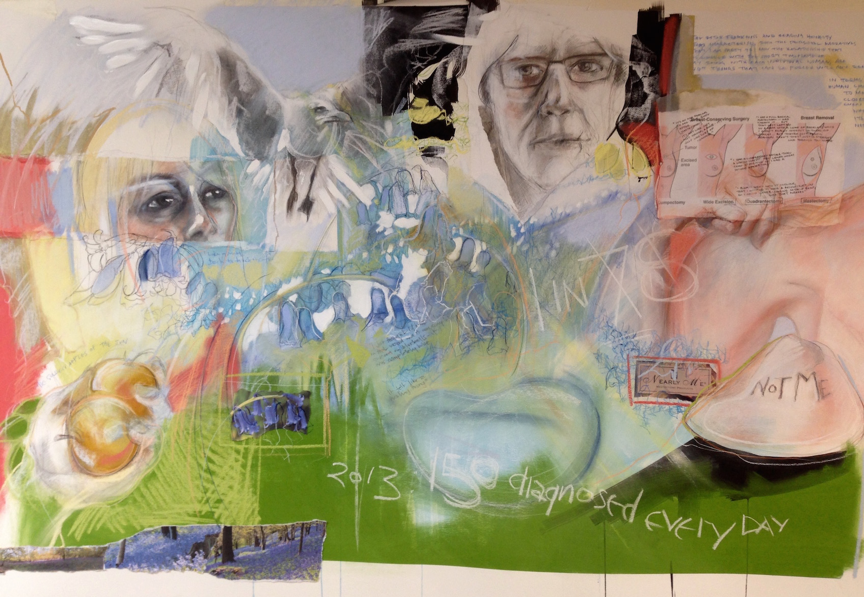
From Me to You
As an artist I respond to experience, primarily my own, in response to what I hear and see around me. To engender this response, and as one human being interacting with others, I prioritise empathy and respect, along with aspects of autobiography and ethnography. I can never forget that I am a subject, just as are all of the people I work with within the cultural milieu, and my autoethnographic perspective cannot therefore degenerate into solipsism but rather serves to legitimise the personal context by acknowledging the complex connection between the individual and the cultural. The art I make is a form of communication through practice wherein there is unavoidably embedded a profound interrelation of self-reflexion – in the thick of the action – and reflection after the fact. I have discovered, and I use that word deliberately, that it is the idea of the abject that gives the work I do its credibility, and hopefully value.
Kristeva notes that the abject indicates ‘that which disturbs identity, system, order, and disrespects borders, positions, rules’. Abjection occurs at the point where a sense of normal identity becomes unbearable through suffering, where accepted meanings become disembodied through loss of distinction between self/other, subject/object, and the narratives we live by break down and become fragmented. For me, this is paradigmatic of both the illness experience, ‘where sense topples over into the senses…[and] Being [becomes] ill-being’, and, in many ways, the creative process. They both embrace in that which is in-between, ambiguous and composite, and it is within this fragmentation and ambiguity that my focus on the role of art practice in medicine is defined.
So I am the ‘abject artist’. Through creating visual art from my subjective response to individual stories of illness that patients relate to me, I become abject, in my transgression of objectivity, and in generating what I call a ‘meta-language’, a fractured narrative that, drawing on abjection, becomes a form of communication that further transgresses verbal, written and even visual language. Moreover, the meta-language has within itself the capacity – one well beyond my own – to speak the unspeakable, to articulate suffering across social and cultural boundaries, taboo and stigma, and where the ethical role of narrative focuses on stories of personal experience that form a basis for moral reflection, the meta-language, I believe, has the power to influence not just awareness and different ways and depths of understanding, but also practice and policy within the field.
Art is the both agent and advocate of patient autonomy through its unique capacity to engage viewers’ subjective sensibilities and I understand my role as going beyond Radley’s concept of ‘asymmetric relation’ between artist and ill person; it is complete immersion of my subjectivity into the world of ‘others’, where outputs blur boundaries between objective rationalism and the passionate human need to co-exist and share experience. I offer here no claim to objective truth, only profound insight into subjective experience that reveals its own truth whilst maintaining avenues of exploration.
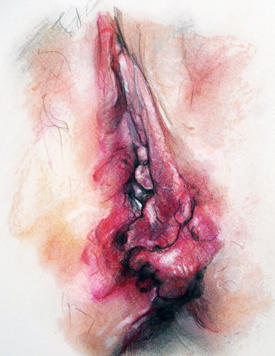
Before surgery
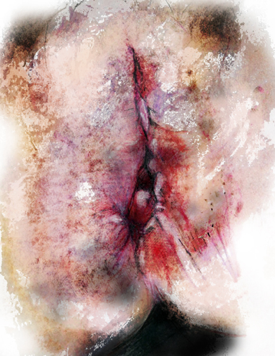
Directly after surgery
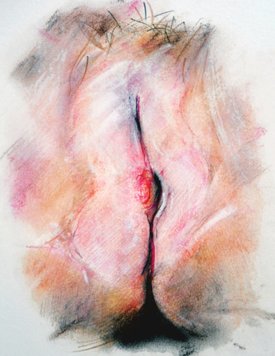
Six weeks after surgery
In Drawing Women’s Cancer, as in all of my work in medicine, dialogue is a key part of the process; dialogue between myself and the subject, between myself and the responsive drawing or painting during the creative process, and between the viewer and the finished work at public art exhibitions. Moreover, it is dialogue that the artwork generates outside and beyond itself that is really important, and where the fundamental aim is to engender a response in the viewer to the subjectivity that is inevitably inherent in the artwork, in the hope that this will enhance his or her awareness and understanding of the experience of the ‘other’. Sometimes the work is challenging, sometimes confrontational but I hope that my appeal to sensation never degenerates into the sensational itself.
In all of my projects the creative process itself becomes the primary vehicle for exploration, simultaneously questioning and responding to the aims and objectives of the study. In practice then, within the interrelation between the clinical and the creative, the academic and the intuitive, the personal and the existential, the aesthetic is considered tacit.
Note about the contributor
Dr Jac Saorsa is an artist, researcher and educator. The links below provide further information about recent projects plus direct contact details.
https://jacsaorsa.wordpress.com
https://drawingcancer.wordpress.com
https://drawingof.wordpress.com
https://medicineunmasked.wordpress.com
https://doctorpatientdoctor.wordpress.com
https://cancerward12.wordpress.com
© the artist