


Kevin Sinnott
The Welsh Valley Historical Paintings
based on a talk to CASW, 24 January 2017
Wall Tin Opener is a very simple picture, but for me a very significant one. In the summer of 1974, after a number of years when my work had been ‘ideas’ based – often installations of conceptual objects – I underwent a mini crisis assessment of the work, to find the kind of art that really excited me. I discovered through the very basic demonstration drawings of the objects I was building that direct immediate drawing, with no shading or corrections but just an urgent line carrying information, was exciting enough for me.
That summer I feverishly filled a large drawing book with anything that was in my field of vision, trying not to edit or select or crop. This picture was the first painting that resulted. It was painted in the kitchen of our north London flat.

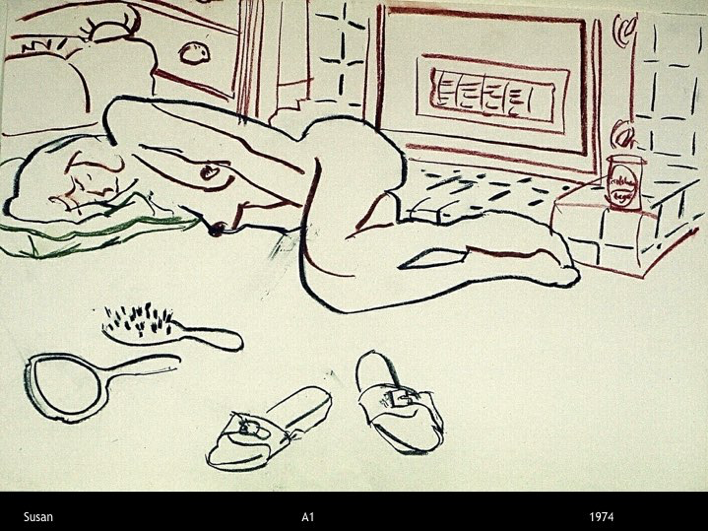
Susan A1 is a dry pastel drawing executed in the same spirit as Wall Tin Opener. Once the pastel had contacted the paper the line had to be continued with hope.
The Studio is one of the last paintings executed in college 1974. This work was carrying along the lines and direct technique of Wall Tin Opener but with some ‘knowing’ and ‘mischief’ by the inclusion of Sir Kenneth Clark in my studio. At the time, his TV series Civilisation was proving very popular.
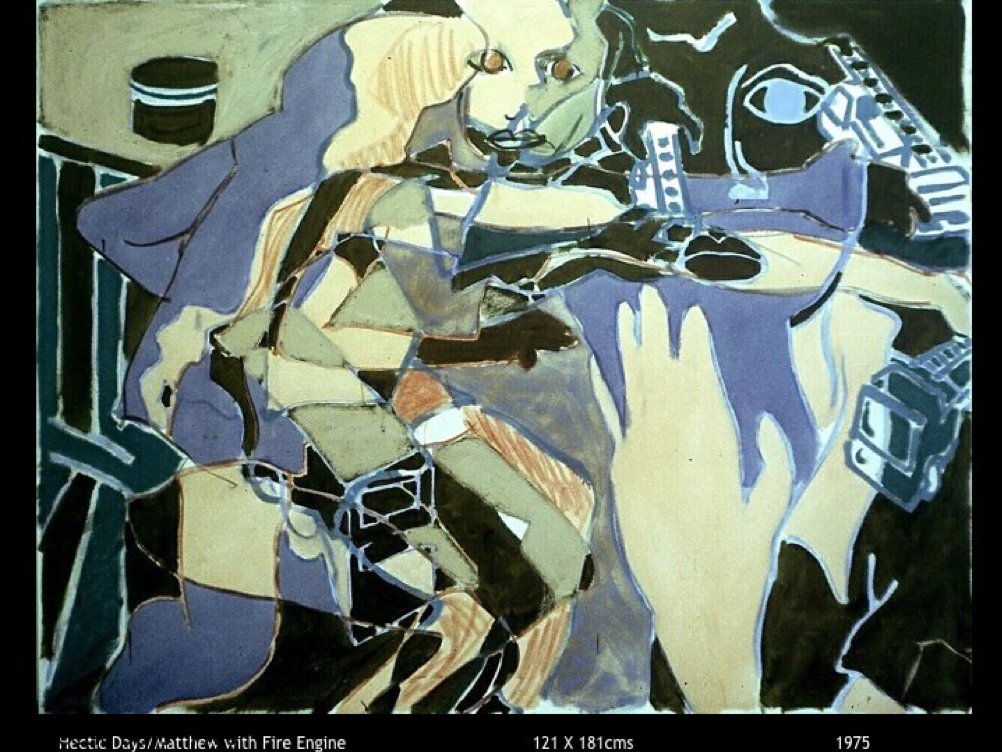
By 1975 I had been out of college for a year, and though the paintings had, I believed, taken on a degree of sophistication (a kind of emulating of the main planks of western modernism i.e. cubism and abstract expressionism), they still held the essence of that direct simplicity from the summer of 1973.

Hectic Days / Matthew with Fire Engine is a large canvas. Without any preparation and once the surface had been prepared, I drew my son Matthew, who was playing in my studio, in simple dry pastel/pigment sticks that I had moulded myself. After covering the surface, I would repeat over the top of that drawing with another and possibly another again, creating a field of transparent form.
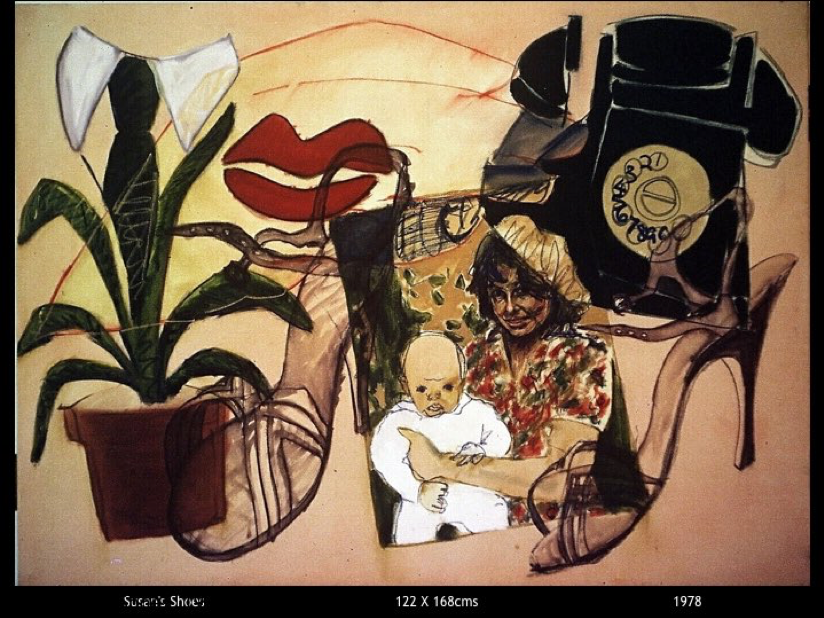
Susan’s Shoes, completed in 1978, is a mix of domestic life, glamour, nostalgia and loss.
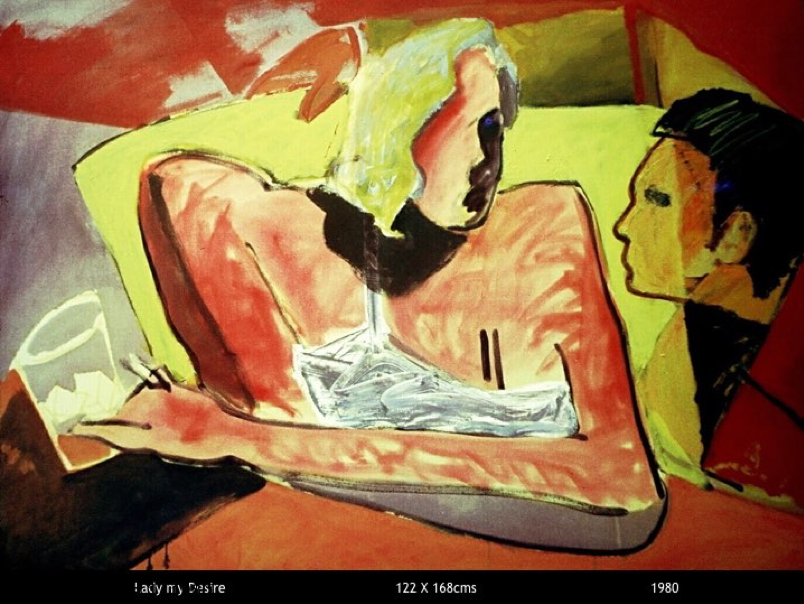
Lady My Desire is one of a small series of paintings that carry the same title – a line from a medieval love poem. The series was exhibited around the country: St Paul’s Gallery in Leeds, the Ikon Gallery in Birmingham and Riverside Studios in Hammersmith London. The series grew to include other work of a flat decorative space. They took me into the 1980s when I started to exhibit regularly in London. The flat yet determinedly figurative style had echoes, I see now, of Matisse.
Why is one of my first works in oil colour. I had painted in oils way back in my teens before I went to art school. Nevertheless in 1983 this was a significant move as it coincided with a massive reversal of all my previous thinking and leaning toward modernism – the evolution and development of twentieth century art.
I have written about this time in my development in my book Behind the Canvas (Seren, 2008) in the chapter ‘Depth or Decoration’.
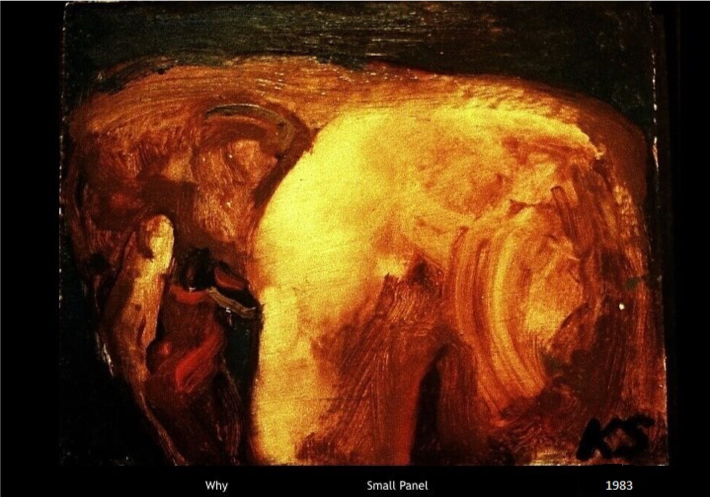
In order to successfully reintroduce myself to oils, I was working on lots of small gessoed panels – mdf or hardboard. These improvisations had no intended subject matter. They began as a way of getting used to my new medium. What I found was that the more I worked without any pre-meditated subject/content, the more powerful symbolic images emerged – seemingly out of nowhere but no doubt loitering in my sub-conscious: half memories of all the past art that had passed me by.
Work is another of those oil improvisations on panel: another image that presented itself to me like a gift.
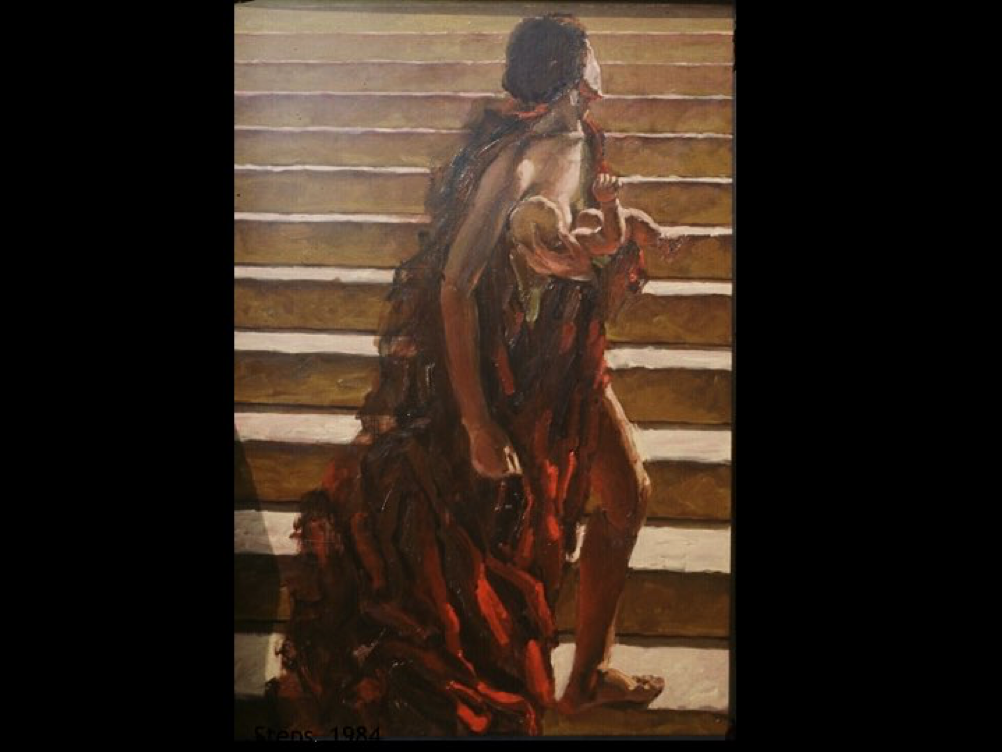
Steps, completed in 1984, was one of my first major oil paintings. My rejection of modernism by this stage had become radical. For two years I had been dealing with these aesthetic issues in private. It was still a very personal issue. By the time I painted Steps, however, the time was due when I would be coming out. I was a tutor in St Martin’s, a stronghold of Modernism where Anthony Caro ran sculpture and the great Gillian Ayres painting. I remember feeling that I should speak to one of the senior tutors and come clean about my apostasy. It seemed that the reverse gear that my car had slipped into was speeding out of control.
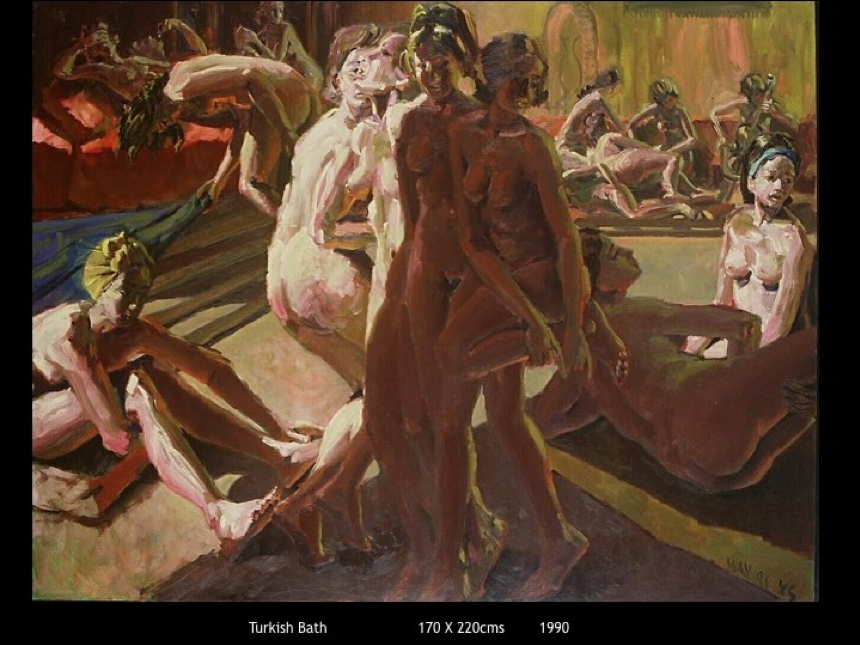
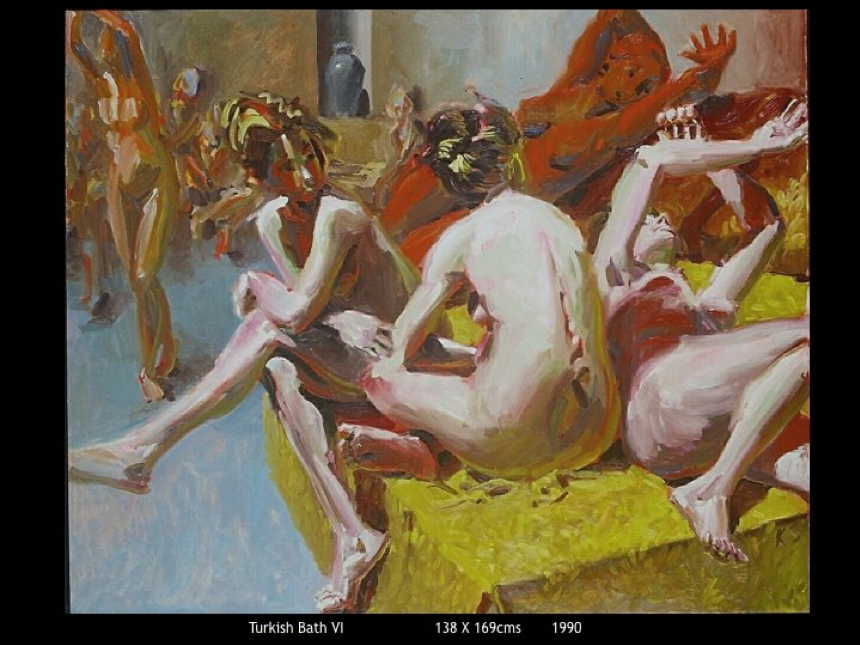
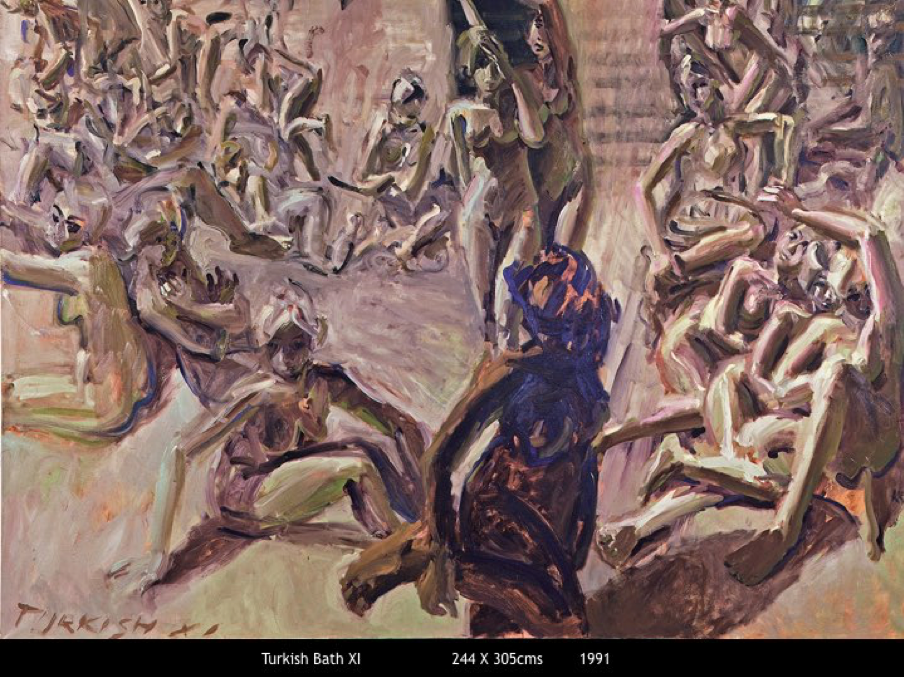
Here are three paintings from the Turkish Bath series of thirteen large paintings, based originally on Ingres’s round composition of the subject. As the series grew I was alluding back to the Renaissance and Titian’s series of mythical sensuous subjects that he painted for the King of Spain.
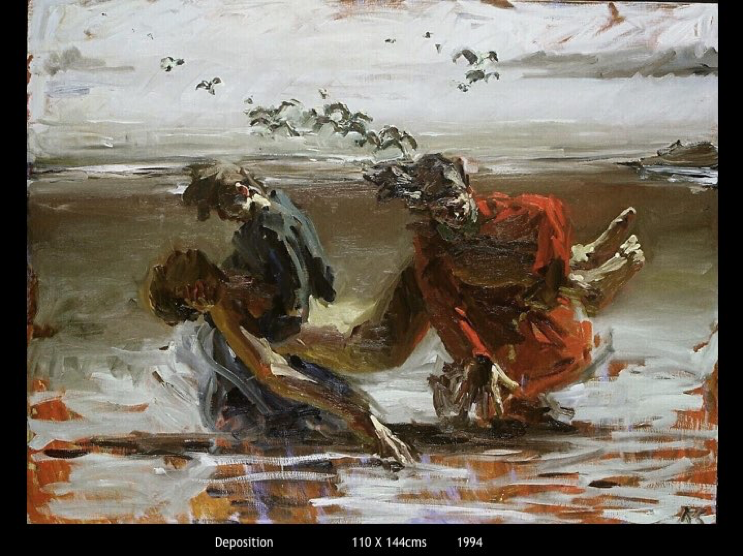
Deposition is one of a series of ‘Fallen Men’ paintings that may be traced as a reaction to the Turkish Bath series. They were included in my London exhibition of 1994 in Flowers Gallery. The execution of the paintings spanned our departure from London in 1993: they were finished in the Llynfi Valley. Though they were conceived in London, they were all set against the low horizon of a shore recalling the south Wales beaches of my childhood and to which I would be returning. Deposition is one of the paintings completed entirely after my return to Wales.
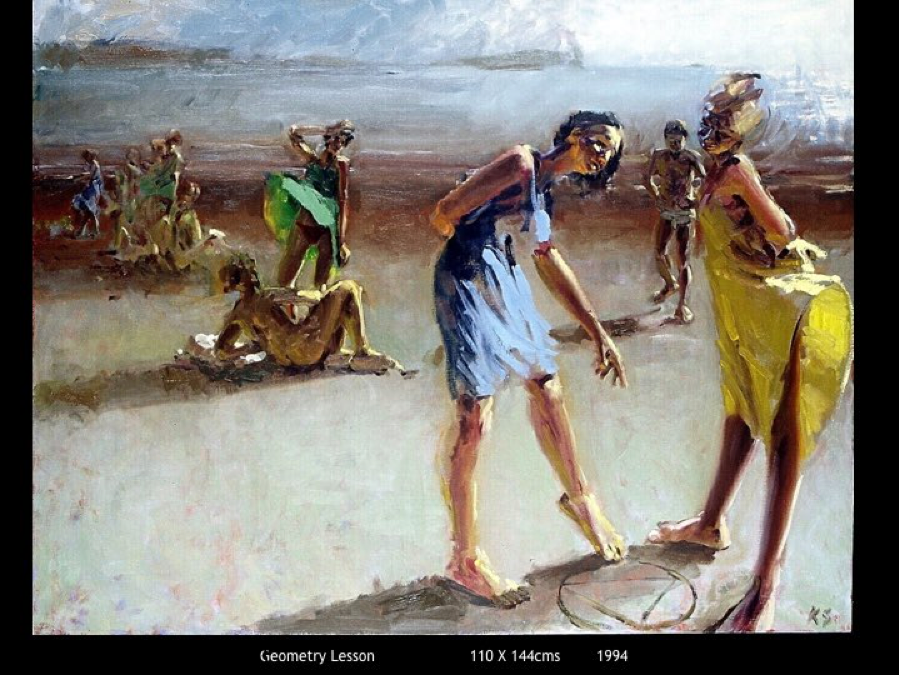
The small improvisations on panel for all of these early Welsh paintings – including Geometry Lesson – had been completed in London and travelled down with us and the cats, like a packet of seeds for cultivating.
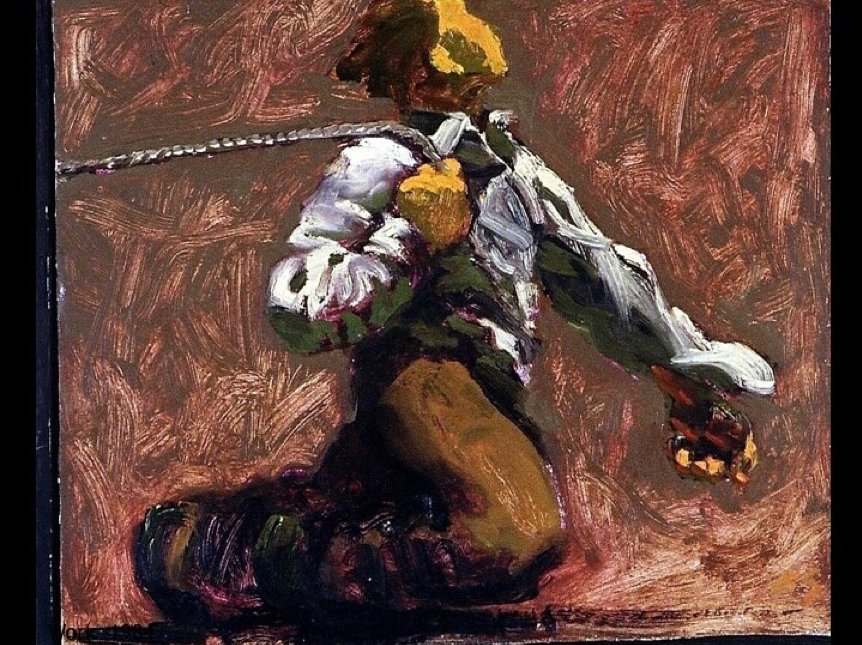
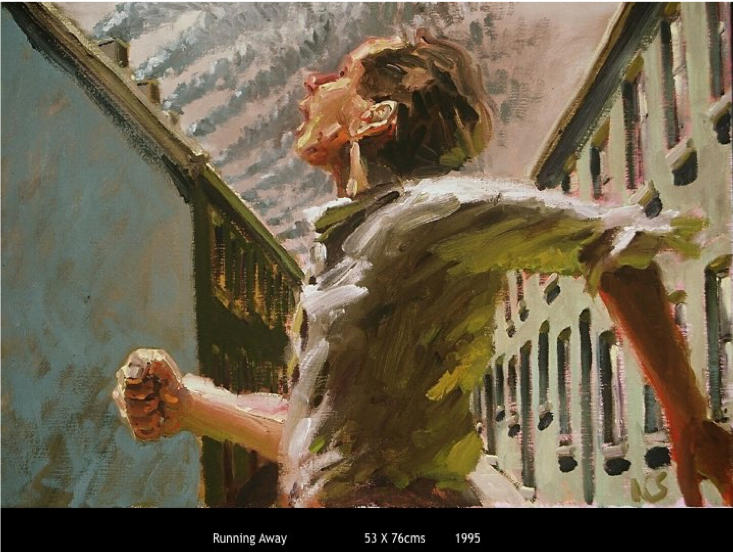
The single figure in Running Away came from nowhere. The place we rented in the Llynfi Valley was near a meadow with a cluster of birch trees. On late summer evenings, I tried to paint the light falling through these trees. Then I tried to paint a figure running across this light imagining a kind of strobe mosaic of light fractured across the figure. Far too clever, but I salvaged the simple idea of the top half of a single figure running across the canvass. It was strong enough so as not to need the over embellishment of all that strobe lighting idea. And of course the terrace houses provided me with a narrative that suggesting running away from something, rather than just physical exertion.
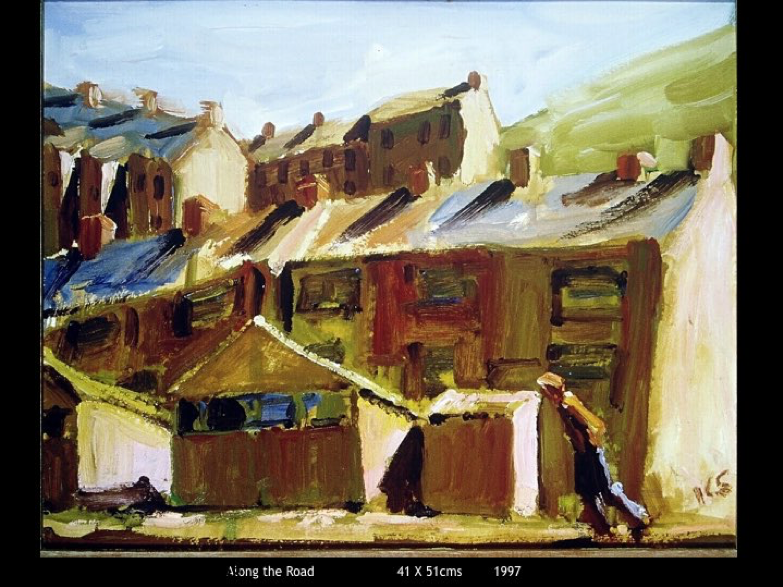
Along the Road is based in Station Road, in Lluest, Garw Valley, where we eventually settled. It is a narrow valley that has stamped its presence on my work since 1995.
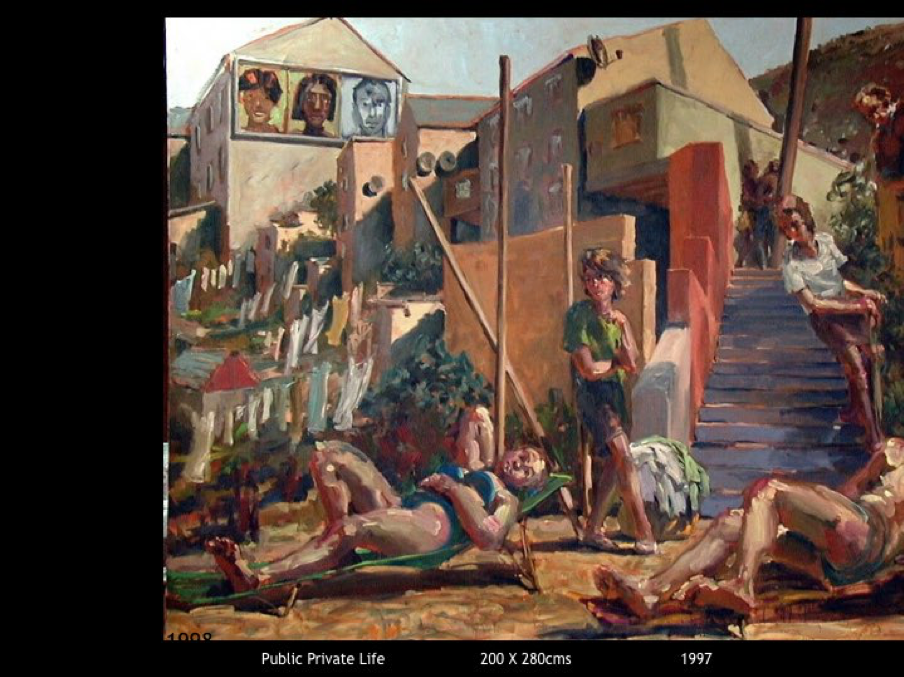
Public Private Life was painted in 1997, a year after we had moved into a reconstructed church. It was an ambitious undertaking. Looking back I think I wanted to paint something for the Garw Valley that would resonate much like ‘Running Away with the Hairdresser’ had done for the Llynfi.
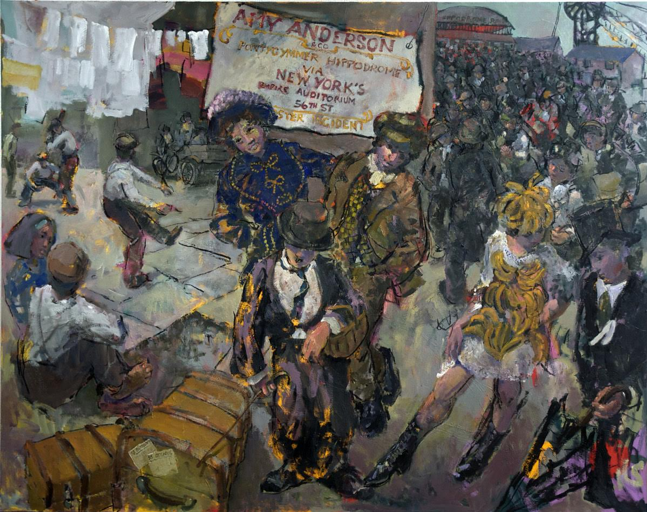
London, New York, Pontycymer is the first of what have become known as my History Paintings. It tells of the arrival of a music-hall family (the Andersons) in Pontycymer in 1909. They hailed from London and after spending one season in New York returned to the UK where they mysteriously managed a former roller skating rink as a hippodrome of entertainment.
By 1922 the very large edifice of the place had burnt down and with it, as the decades passed, its memory. There remains a grandson in Pontycymer of Amy Anderson, probably the leader of the troop with her vivacious beauty, singing and dancing. She could have no doubt graced the stage of a Lloyd Webber West-End production today.
Background note
Kevin Sinnott lives in Pontycymer, south Wales.
His website – http://www.kevinsinnott.co.uk/ – includes retrospective images plus recent work.
© the artist