Zoe Preece
Material Presence
Based on a talk to CASW, November 2019
The work Material Presence came into being as a result of my being awarded a Production Grant from the Arts Council of Wales towards the end of 2016.
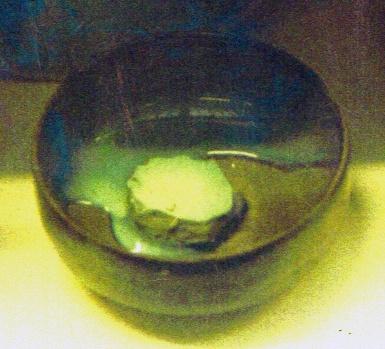
I discovered this kiln waster many years ago in a display cabinet in the Victoria & Albert Museum. It has been a significant object for me; a beginning for some of the themes running through the work I make now. I still have an image of it on my studio wall.
Kiln wasters were traditionally used to pack and fill a kiln in order to regulate the movement of heat within the kiln chamber during firing. They are not intended for use beyond that, and in that way they mirror for me the role of the domestic space; they exist and function as a backdrop.
This particular kiln waster had some glaze that had dripped from another vessel and pooled in the centre of the bowl. What particularly drew me to this object was its status, and also the material quality of the glaze that had pooled. Its function was backdrop, and yet I found it displayed in a glass cabinet in a museum, so there was also a questioning of status that I was interested in. The glaze appeared as if it might still be pooling, still fluid and yet to touch I knew it would be hard. An active moment seemed to have been caught still.
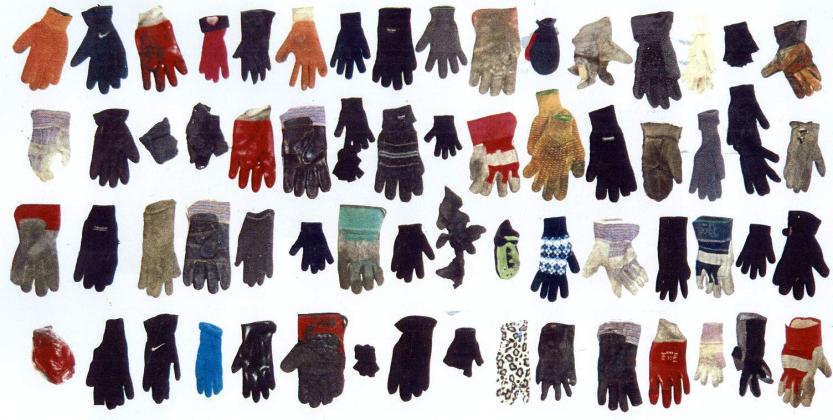
Around the time I discovered the kiln waster I was also collecting lost gloves that I came across on the streets. I found one that was particularly interesting to me. It was on a road and had been driven over lots of times, so much so that I had to peel it off the road when I tried to pick it up. It was completely misshapen and barely recognisable as a glove – I believe it was that one right in the middle of the slide – and I found myself asking the question, at what point would this glove be considered more road than glove? How many more times would it have to be driven over for this to be so? And where is the boundary line between the two, where is the point of transition?
This was the beginning of an awareness of my interest in the borders and boundary lines we create through language. While I was thinking about these questions I was also testing out fluxes in porcelain clay, and thinking again about the ways in which we categorise things; I was looking for the transition point between clay and glaze. At what point – how much flux how much heat – before the clay might be termed glaze?
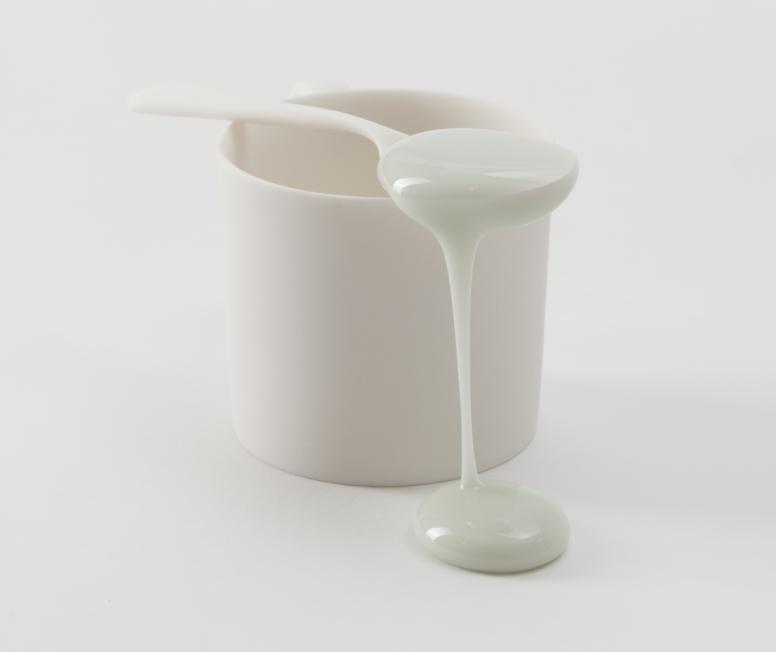
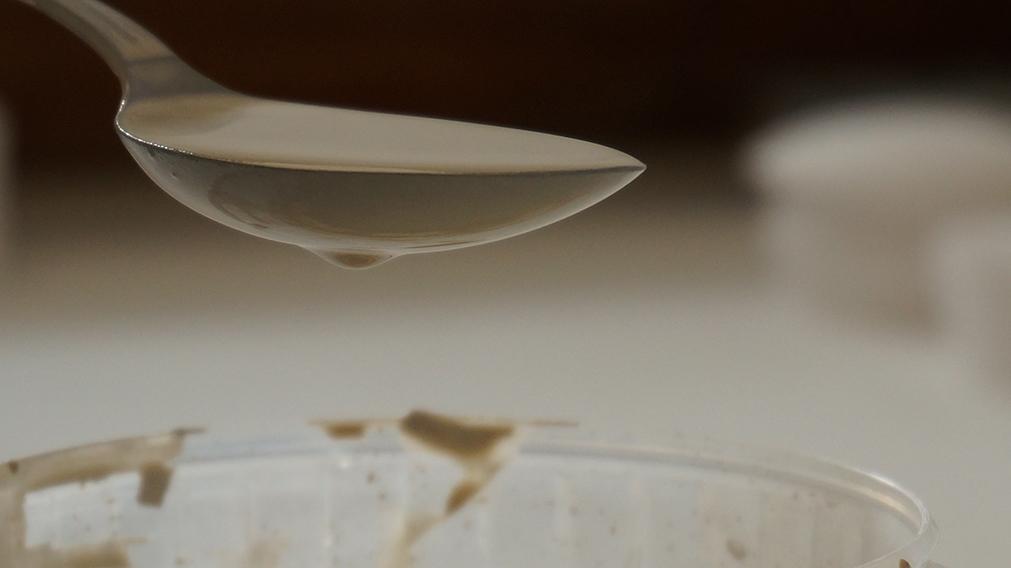
So these are some of the quite distant origins of the work Material Presence that still have significance for me. The image here is an espresso cup with a spoon dripping with flux in Material Presence.
Anthropologist and writer Tim Ingold talks very articulately about material and processes of making and he does this I think in a very beautiful way. His basic premise, as I understand it is one of co-existence and emergence. He diffuses a human centric notion of the world and instead develops the idea that in any process of creation we are living and working alongside our materials, in collaboration with them. He describes a world in which we swim in an ocean of materials, materials that are both active and responsive to their conditions; and rather than viewing ourselves as separate or apart from those materials, he argues that we are them, and we exist amidst and in relation to them.
When I think about these ideas in relation to the domestic realm – the site of this recent work – I find it brings me closer to that realm. I become a part of it, rather than an observer of it. I am no longer a subject moving around an inanimate space made up of inanimate objects. The space and the objects instead take on a vibrancy, an aliveness, a presence. They become more than their function. It is this material vibrancy that I have endeavoured to express in the work.
Both Descartes and Irigaray are talking here about wonder. And this idea of wonder has been important in relation to the making of the work Material Presence.
I want to think of making, instead, as a process of growth. This is to place the maker as a participant in amongst a world of active materials. These materials are what he has to make with and in the process of making he ‘joins forces’ with them, bringing them together or splitting them apart, synthesizing and distilling, in anticipation of what might emerge … Far from standing aloof, imposing his designs on a world that is ready and waiting to receive them the most he can do is intervene in worldly processes that are already going on…adding his own impetus to the forces and energies at play …
TIM INGOLD, MAKING
When the first encounter with some object surprises us, and we judge it to be new and different from what we formerly knew, or from what we supposed that it ought to be, that causes us to wonder and be surprised; and because that may happen before we in any way know whether this object is agreeable to us or not so, it appears to me that wonder is the first of all passions.
DESCARTES, THE PASSIONS OF THE SOUL
In order for it [wonder] to affect us, it is necessary and sufficient for it to surprise, to be new, not yet assimilated or dissassimilated as
known. Still awakening our passion, our appetite. Our attraction to that yet (en)coded, our curiosity . . . vis-à-vis that which we have not yet encountered or made ours.
IRIGARAY, LUCE, WONDER
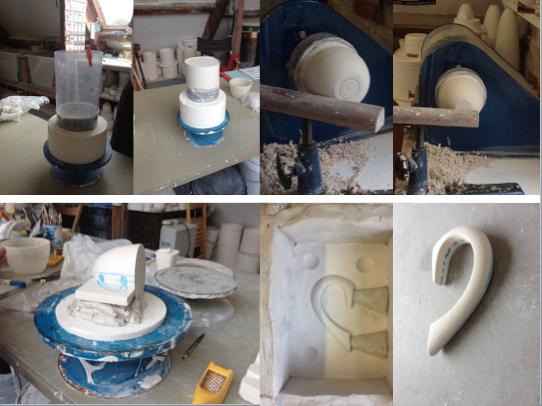
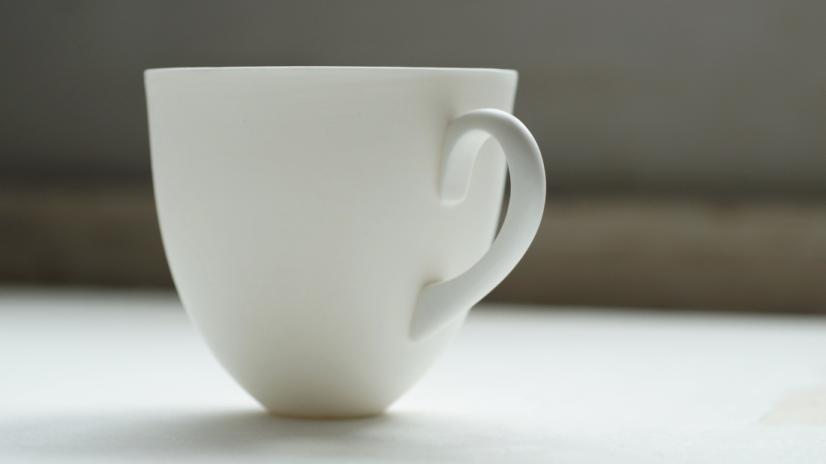
I did some training a few of years ago with Sasha Wardell, a master in model and mould making in plaster, and slip-casting. During the week I spent with Sasha I made my first ever bone china teacup from scratch. From plaster I cast a solid block, which I then turned on the lathe to produce a model of the body of the cup. I then poured more plaster onto the side of the cup and from this I carved a handle, which would fit perfectly to the body. I then made a plaster mould of each and cast the cup in bone china. It was fired to 1280 degrees.
When that cup came out of the kiln it seemed to me as if it might be the most wonderful thing I had ever made. I had an experience of wonder. From raw materials, through a series of processes, I had fashioned this very fine bone china cup. I believe that experience of wonder had something to do with the familiarity I had with a cup – they are ubiquitous objects after all – and yet at the same it was as if I was experiencing the cup for the first time. It was this experience of wonder that I wanted to provoke through the work.
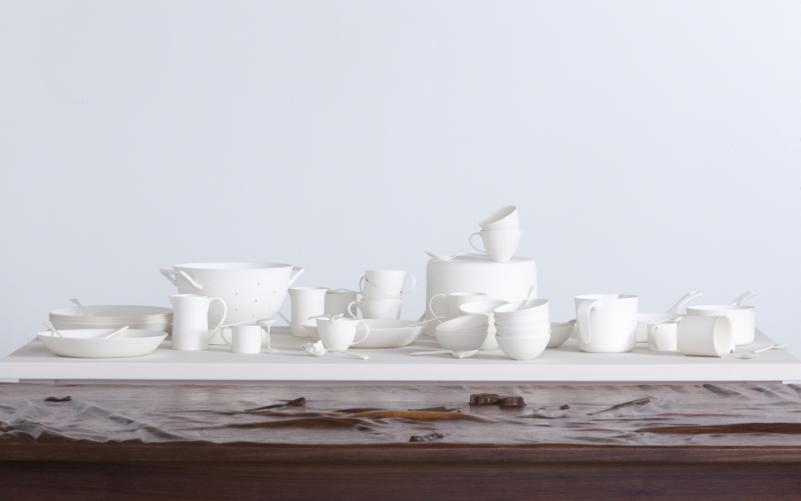
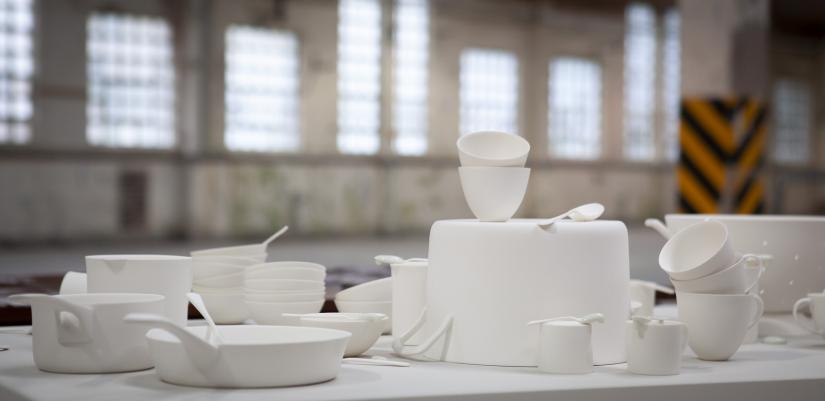
For Material Presence I have made domestic objects – a saucepan, a mug, a colander. I have endeavoured as much as possible when carving them on the lathe or by hand, to replicate the forms of those objects as true to their originals as I can. It was important to me that there was no ambiguity of form. At the same time the forms are pared back, they are stripped of colour. I’ve used the single palette of porcelain; they are blemish free. So as the viewer you are left with no distraction, just the lines and curves of the form, and the smooth white surface of the porcelain.
I wanted to create that familiarity with the object and at the same time unfamiliarity. It was an endeavour to reintroduce you as viewer to an object you might see and use on a daily basis, and a hope that you might have something of that experience I had when I first made that bone china cup.
One of the interesting things for me about wonder is this idea of our experiencing something before we have decoded it, before we have categorised it as this or that. It is that space that I am interested in. The tension between familiarity and unfamiliarity helps create that. It’s a space of creativity I think – in the widest sense of the word – when we endeavour to suspend what we think we know in order to be able to look again with fresh eyes as if looking for the first time. This idea feels quite central to the work as a whole.
Idea
Idea generation happens in different ways for me. I will very often become hooked on a particular visual image, for example the meniscus that forms on a spoon filled to the brim with liquid.
I read a lot too. I listen to books as I work in my studio. I read about 30 books during the making of Material Presence. And words are very often catalysts for ideas, or rather they sit alongside visual images and together they create something. For example, I read something by Susan Sontag during the year I was working on Material Presence – part of it became the title for the porcelain work. She said, ‘My library is an archive of longing.’
I particularly liked the way Sontag brought words with very different qualities together. The word archive for me conjures ideas of order, of organisation, a systemising of things and the word longing conjures something very different, something much more primal, something wilder and more emotive. A tension exists as these two very different qualities are brought together. And there is a mirroring here for me in the way I use materials, in the relationship between the refined formal structures of the porcelain objects and the transitory moments of flux.
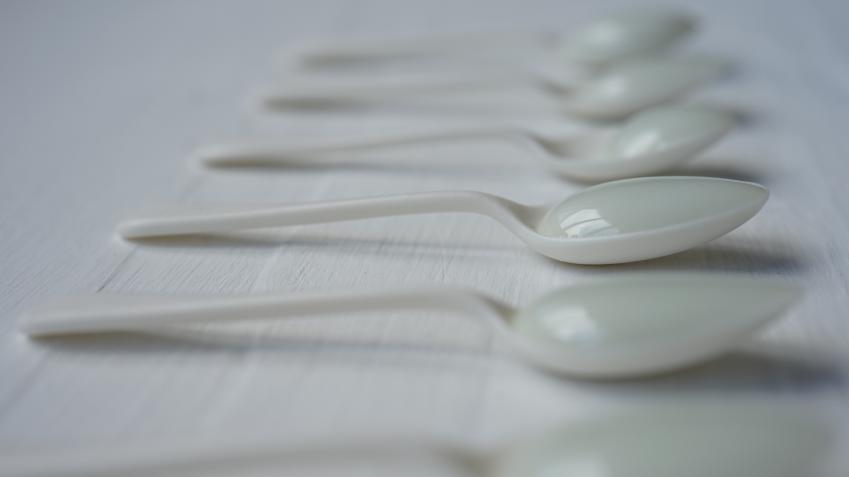
For me the fluxed material that drips from the spoons embodies a quality of longing as it reaches beyond the borders of the spoon. When I think of longing I think of a reaching out beyond the confines of oneself and one’s present circumstance. I also felt as I removed all trace of human touch from the porcelain forms that in themselves they possessed a certain longing – to be touched, to be used.
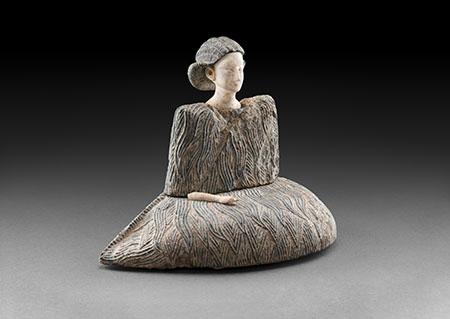
I see these ideas mirrored again here in this Bactrian Princess. She was carved from stone around 2000BC and was thought in Central Asian mythology to be the one great goddess who reigned over the natural world, pacifying the elemental forces. I have a great love of her. She has a quality that I wanted in some way to create in this work – a stillness, a dignity, a grace – and yet also a feeling of those elemental forces contained within her.
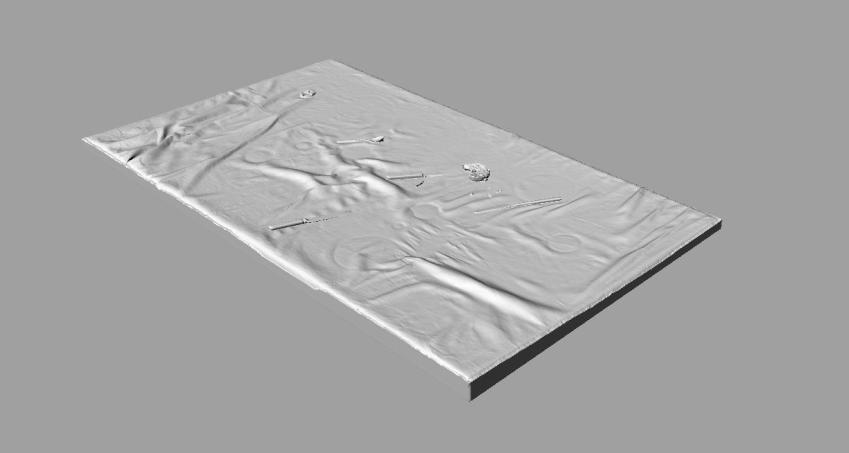
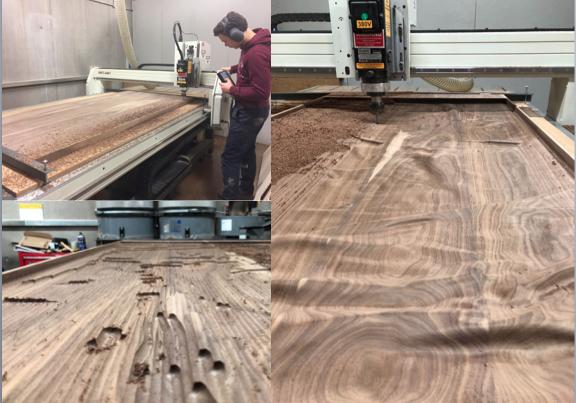
This is virtual model of the scan I took of the tabletop. My process in my studio is generally quite a solitary one, so the production of the table was a very different experience. It was first time for me to collaborate on a creative project. I was collaborating with the technical staff in the Fablab, and I surprised myself; I found it to be a tremendously rich and enlightening experience, working alongside people with different but very particular and refined skills towards a common end. What became very evident to me during this process was the level of nuance that exists within these technologies, no less so than in those processes I use within my studio with clay. The type of drill bit, the speed it spins and moves across the surface of the wood, each aspect of the process is significant to the outcome.