


Clive Hicks-Jenkins Interview PART TWO
The ‘Gwrach/Witch’ Exhibition
Renn: This ties us in well with talking about the Gwrach/Witch Exhibition because I think you wrote about it on your blog that it’s been essentially a sort of a 15-year project.
Clive: Yeah, it’s like putting a paper boat onto a stream and thinking where is it going to go.
Renn: It would be nice to hear more about the exhibition – where the paper boat began and how it all evolved.
Clive: I know exactly where it started. I can show you. [Clive gets out a book from his bookshelf].
Renn: Oh yeah, you did mention this on your blog, Toby Twirl.
Clive: Toby Twirl, The Little Pig.
This is a replacement for the book I had when I was a child but these are the first books I can remember as a child learning to read. This particular edition, ‘cause it was an annual, is the one I remember so well and that’s where it all began.
Renn: Is it specifically the story?
Clive: It’s the witch.
Renn: Do you mean the story or is it more the image of the witch that struck you?
Clive: It was the idea that you could be going through life and everything is fine and dandy and you are with your friends. Then suddenly, out of nowhere, something happens that changes the trajectory completely and y’know – I would have been four or five –it was the physical image of the witch which caught my imagination.
That witch stuck in my head and it kind of formed a fascination with the archetype of the witch. It’s an archetype that I now recognise, as a cultural historian myself, that whilst witches are frightening, they are also incredibly seductive. We all like to look at Cruella de Vil in 101 Dalmations because she’s so evil and so mean but she looks so great. Physically she’s mesmerising.
Witches have crept up in my work in the theatre. I think I directed at least three productions of The Wizard of Oz and I only ever did them because I wanted to work with the witch…
[Renn and Clive both laugh]
…because the witch in The Wizard of Oz is so good.
A few years back, I did a whole set of Hansel and Gretel plates and they were quite dark. I wasn’t really consciously thinking about the way I was changing the story to fit my narrative, to fit what I wanted to put onto these plates. The witch was quite funny. She was kind of mumsy with a headscarf and a handbag – I think I was channelling Margaret Thatcher. There were symbols. I’d reduced the whole story to symbols – an oven with a pair of legs sticking out of it, a cat, some gingerbread, really just riffing and playing. They never really went anywhere. They just ended up in our kitchen.
Hansel and Gretel is a not a fairy tale. It’s a folk tale and it’s been changed by subsequent retellings. If you go back to the original story it’s odd and it’s unresolved and you know this is a child murderess [Gretel], she kills an old lady. You are led to believe that it’s because their lives were in danger – she had to gird up her loins and kill someone. They didn’t just escape. When they get home, the evil mother who has betrayed them has gone. She’s dead. And how did that happen? It’s all very unresolved and you can be under no illusion that the witch kills and cooks children. By the time that turns into an opera – by Englebert Humperdinck (his sister Adelheid wrote the libretto) – the witch is still baking things but she’s baking lovely gingerbread babies that decorate the house and once she is killed, all the gingerbread babies come back to life again. That’s what Humperdinck wanted for an opera to be successful at Christmas and bring lots of people into the theatre. So, no eviscerating children and cooking up stews – it’s all gingerbread babies who get brought back again after the witch is killed. People think that’s the story of Hansel and Gretel.
So I made those tin plates. There was a magazine article, a picture book, a toy theatre for Benjamin Pollock’s toy shop and a stage production which was a big deal – two years of work, opened at the Cheltenham Music Festival, toured the country, ended up at the Barbican. Simon Armitage asked me to find a publisher to publish the libretto as a poem and to illustrate it. That book won me the V&A Illustration Award 2020.
Renn: That must have been a full-circle moment with you going to the V&A as a child, loving it and then winning an award all those years later for your work.
Clive: Yes, yes! It was great. The only thing that was a minus was that it was covid year which meant that everything was delayed. I had to chase them up for my prize money and my prize! But it won me a lot of credit.
At the end of that, I just had the feeling that I had so much material. I hadn’t intended it to be like that. I felt that there was something there that needed to be protected. With so much material, I felt the only way to make something of it would be to do an exhibition.
The exhibition grew in stature and ambition through the five year period from when it first was agreed to when it was finally put up in the gallery. The curators really got on board with it – lots of discussions of how we would do it before the designer, Meriel, and Simon Costin, acting as consultant joined us. It went from something that might have been that big *hand gesture showing small distance* to something that was quite extensive.
Renn: So, was the exhibition about your art practice and how you work or was it just the work itself?
Clive: I think that it showed somebody taking the story of Hansel and Gretel and riffing on it, turning it into an orchestral piece. The curators cleverly led people through so you could see the trajectory of the work from the beginning. There was a Welsh dresser with the enamel plates on and then there were the drawings that became the magazine illustrations that became the picture book that became the toy theatre…. It also became a journey because there were so many filmed elements. We were able to take all the animations – all the filmed elements – that I’d produced for the stage production and project those onto big screens. It was kind of an immersive world of a fairy tale that is sometimes known as Hansel and Gretel…but we didn’t want to call it that as we didn’t want people to think it was a kiddies’ show.
Renn: I love the name ‘Gwrach/Witch’
Clive: Yes, it bridged a gap that enabled us to get a different kind of audience and children did go but they just didn’t go expecting sugar icing. We wanted there to be darkness and there was quite a lot of darkness. You know I love horror and I love humour and I love old horror movies and horror stories and I like that sort of mix of fairy tale with horror that makes you laugh out loud but then makes you go cold. That’s what this was.
Renn: It feels like a high point of your artistic journey.
Clive: I don’t think I will ever have such an enjoyable exhibition again.
Renn: Never say never.
Clive: Well, I think that it went through so many iterations that it would be hard to repeat that. I think it was a one-off and I loved doing it and I loved the people who I met on the journey.
After the interview, Clive took me to his studio. I was able to see various illustrations, paintings and other artworks he’d created as well as a plethora of vintage toys, puppets and other objects which inspire and comfort Clive. A joy to see.
It was a privilege learning about this fascinating artist’s life. He is someone who has really wrung out as much as he can from his experiences, both in the physical world and in his imagination, to feed his considerable creativity.
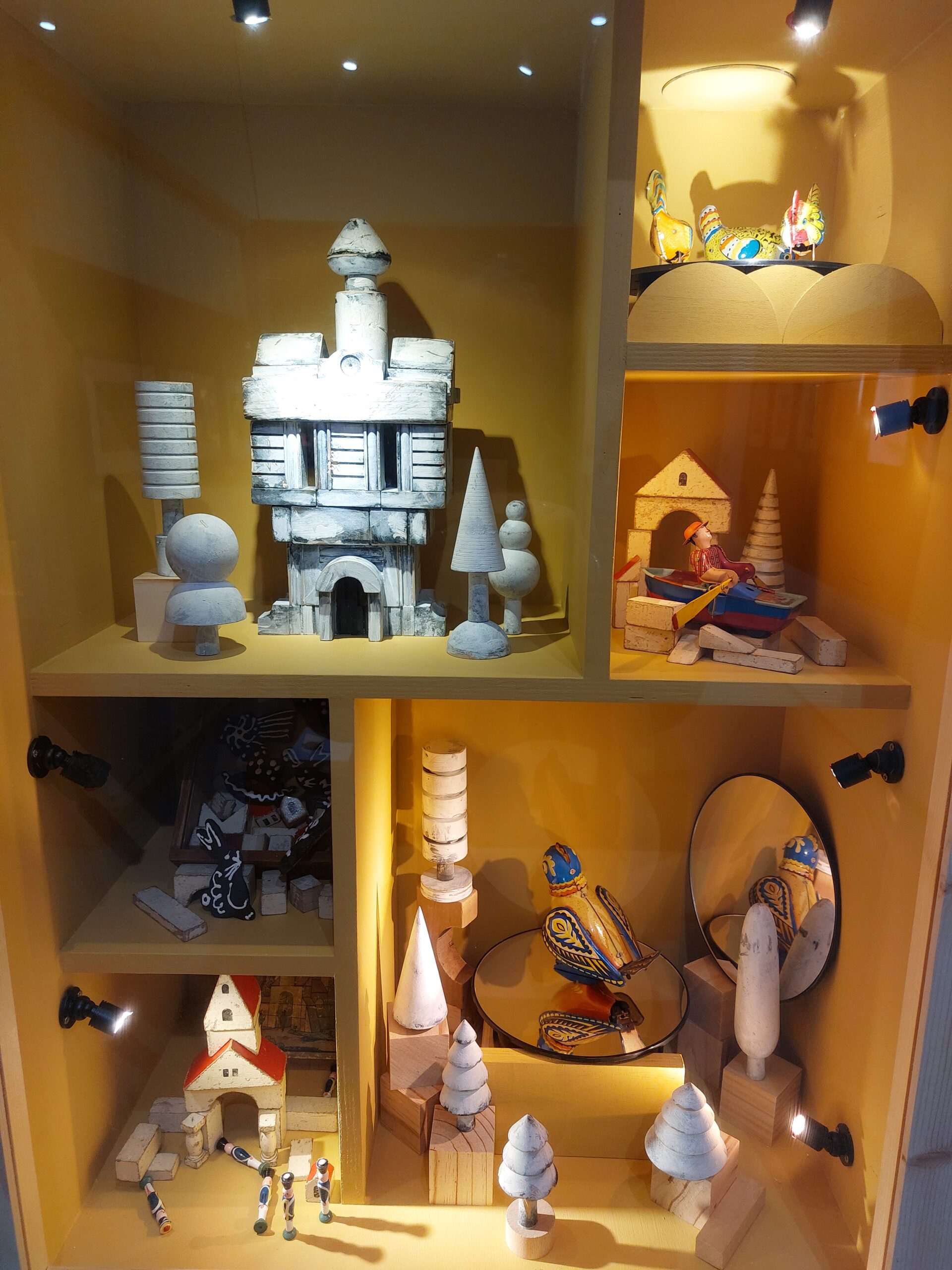
Clive’s exhibition Gwrch/Witch at Oriel Myrddin
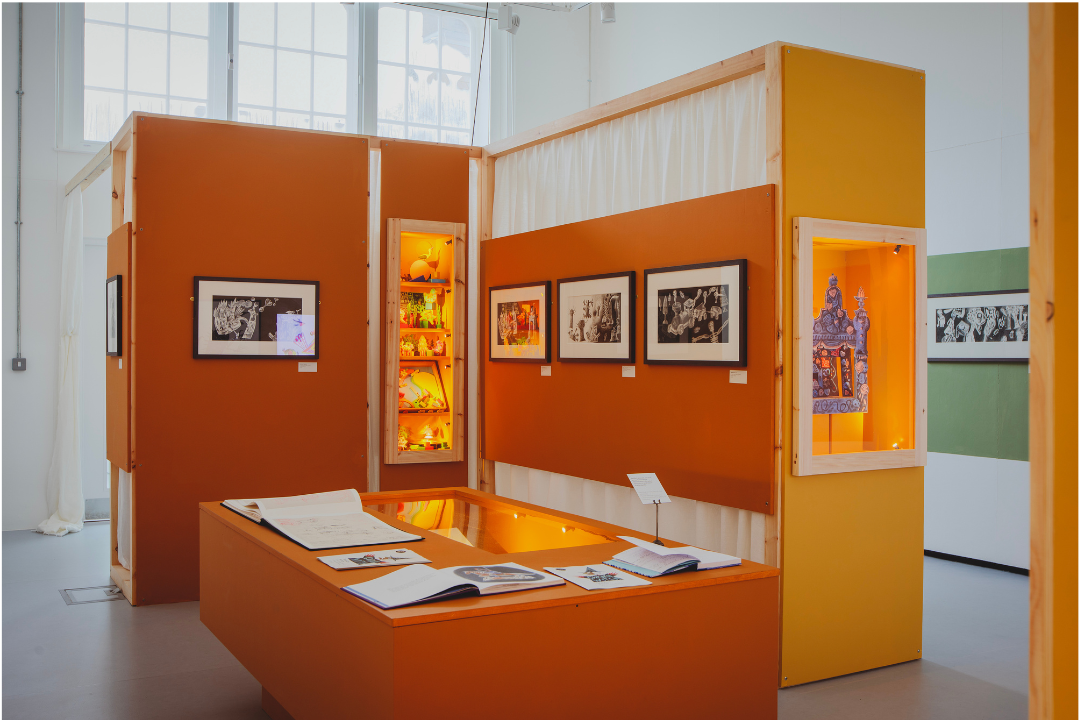
Clive’s exhibition Gwrch/Witch at Oriel Myrddin
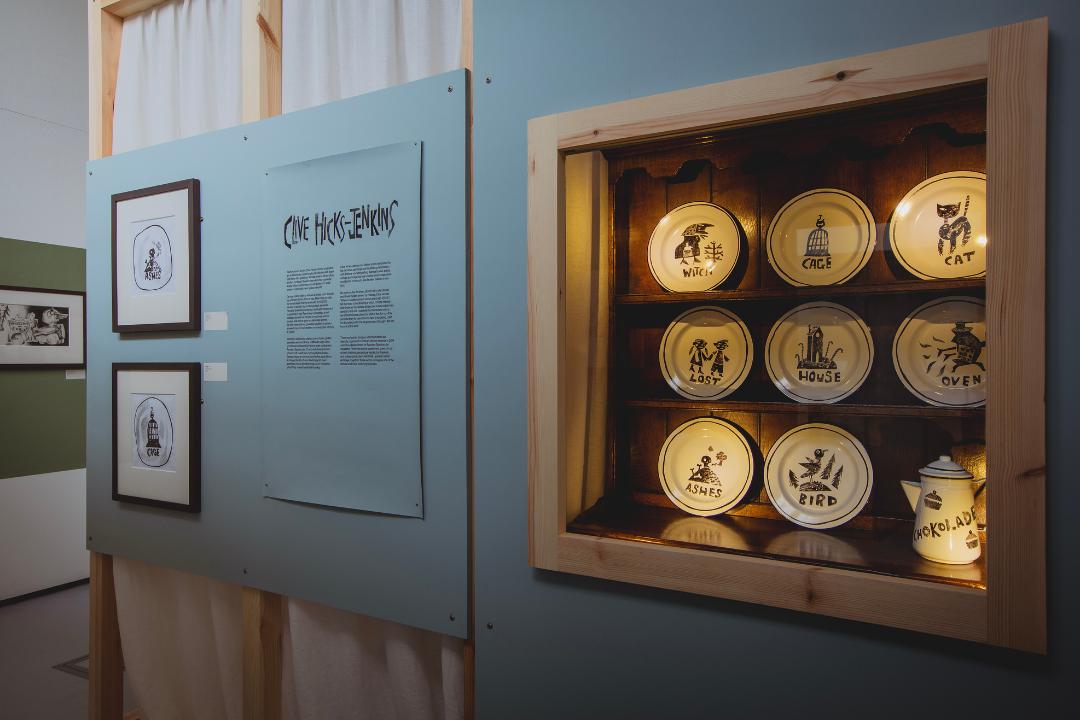
Clive’s exhibition Gwrch/Witch at Oriel Myrddin