


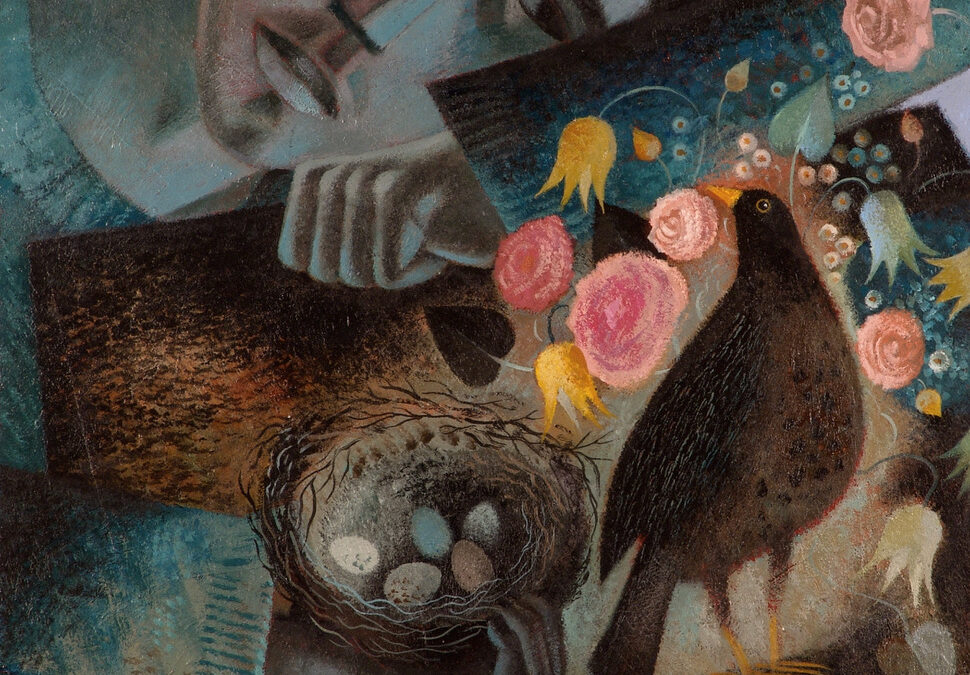
CASW’s Renn Hubbuck-Melly interviews artist and illustrator, Clive Hicks-Jenkins
Renn took a trip up to the lovely home of the Clive Hicks-Jenkins, a successful multifaceted artist working in such mediums as painting, printmaking, ceramics, illustration and theatre. After having a discussion about the features of his charming garden (including the birds which so delight Hicks-Jenkins) we set ourselves up in his library to talk about his life and art practice.
Part 1: From choreography and theatre to visual art
Renn: Could you take us through your journey from how it all began to where you are now?
Clive: I was not doing well at school once I passed my 11-plus. I went to a terrible school in Newport which had a very bad reputation. It was a comprehensive which was good but its pupil to teacher ratio was very high. I just sank. I went from a junior school where I’d been incredibly happy – where I thought the world of education was just an extension of home – to being in an institution where I was sinking without trace. I was in a top grammar stream because I was quite bright but I started going lower and lower. It was only a matter of time before I would be removed to a lower stream. My parents noticed and looked for a way of bringing me back from my unhappiness. Somehow I found myself at Monmouthshire Young People’s Theatre. I think they had connections. They thought it might be good for me and that I might make some friends there. The first class I walked into was choral verse speaking. It was run by an extraordinary woman called Mollie Wanklyn – incredibly theatrical, beautiful but rather severe looking. I had entered a room where there were probably 30 young people from teenagers to 12 year olds, all reciting a poem called ‘Do you remember an Inn?’ She took me by the shoulders and plonked me at the front. Suddenly there was this extraordinary music of voices working together, being told where to breathe and how to use your hard palate and your soft palate… We would do breathing exercises. I suppose it was a little bit like going into a choir except it was verse speaking. I just loved it. All the insecurity and shyness kind of just fled and in this space I could be myself. So I continued with them for a while and when it became clear that I was two different people – one at Monmouthshire Young People’s Theatre and one at Hartridge Comprehensive School – my parents asked again what they could do to make me happy.
I had no notion of what happiness was but somewhere I must have found out that there were places – vocational schools – where you could go. So I said I wanted to go to a vocational school for the arts, for drama.
Renn: What age were you then?
Clive: About 12.
Renn: Wow.
Clive: We lived in Newport and my parents had friends who ran a restaurant called Conti. They immediately said: ‘You’re going to have to go to Italia Conti then.’ So, I went off to Italia Conti in London and auditioned. It wasn’t a boarding school so I went to live with my father’s sister who lived in Dulwich, not far from the Italia Conti school in Clapham.
I began my life, then, as a dancer/actor in musicals – film and stage musicals – and gradually I began to move towards choreography. You coudln’t learn about being a choreographer – not in those days…there weren’t the courses. Choreographers developed from being dancers. So I climbed the greasy pole and I became a dancer’s assistant to several choreographers. When you are a dance assistant, it’s more creative. You’re teaching other dancers even though you are still dancing yourself but you are kind of in charge…you become head boy. When the show is out on the road or when the choreographer isn’t around, you’re in charge of rehearsals and replacements and things like that. That led me to becoming a choreographer. So, by the time I was twenty I had become a choreographer and that remained my career for a while. From choreographer, I became a choreographer director. I progressed by increments.
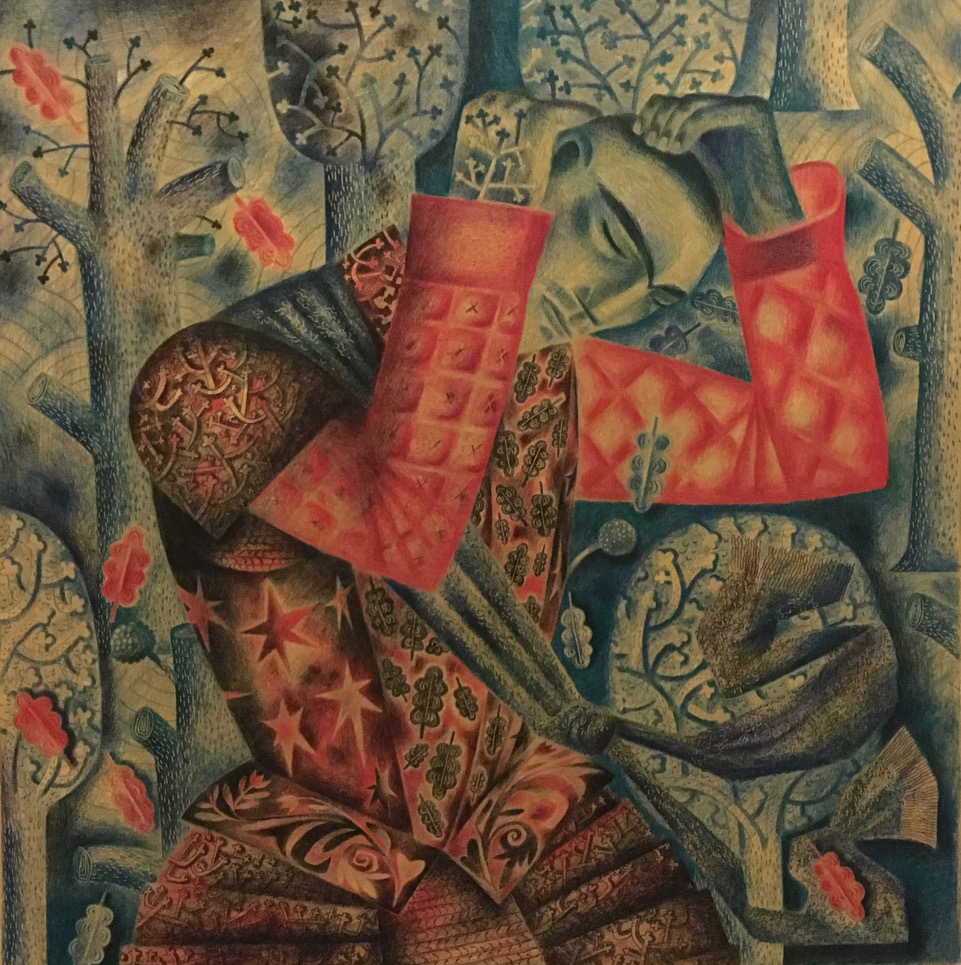
Study for The Stain of Sin from The Sir Gawain and the Green Knight series.
Renn: I guess that goes quite nicely onto the next question I wanted to ask. You obviously changed the mediums you used to express yourself. Why did you choose to move from being incredibly immersed in the theatre world to painting and illustration?
Clive: It’s a rackety old life, the theatre. If you are doing what I was doing, you’re moving around constantly. It’s really hard to broker proper relationships because you are always on the move – you’re living in hotels, you’re on planes – every job is a new invention. Your life becomes regimented by the act of working. Some of that work is wonderful. I did things of which I am enormously proud and there were other things where it all went wrong despite being nothing to do with you – you know, a bad producer or a miscast play. So you’re up, you’re down, you’re up, you’re down. You’re always having to prove yourself. You go from a huge success to something that maybe is not a failure but kind of a bleary or you go from something just awful which you wished you’d never touched to something successful again. It’s a switchback ride and I just grew tired of it.
Renn: That does sound exhausting.
Clive: I think I had some sort of mental breakdown in my mid-thirties. I just felt disconnected, untethered. Everybody I knew was in the theatre. They were either a dancer, a musician, a designer or a producer. I didn’t know anybody in the real world. You only feel really alive when you are working and when you’re not, you’re like a piece of plankton floating in the ocean and thinking ‘what do I hold onto next?’
I came back to Wales and I didn’t know what I was going to do. I didn’t know if I was capable of doing anything else as I didn’t have another profession. I certainly didn’t think of myself as being an artist. I did know that for my own mental wellbeing, I would have to do something that anchored me. It would probably have to be something quite menial because I didn’t have any skills that would get me a ‘proper job’.
I became a custodian at Tretower. That was an extraordinary moment when everything comes together in ways that you don’t expect. I loved Tretower and it gave me a sense of security. While I was there, I met Peter. He was high up in Cadw and I was a lowly custodian but he and I started seeing each other. He looked at the things that I was doing, drawings I made as I whiled away the time and he very quickly said ‘I think that you’ve missed your calling. You could be an artist’. I thought that was nonsense. I didn’t think that there was anything in me that would make an artist but Peter saw something and he encouraged me. So while I was there, I started to draw the things that were around me because I wanted to please him. He had this idea that I could be an artist and I was going to try to be it as I wanted our relationship to develop. It was Peter who took my early work to a gallery. Totally unexpectedly, they took it. That was the Kilvert Galley in Clyro. I didn’t think I was producing anything worth looking at but the person who ran the gallery said very early on to me, perhaps at our first meeting, ‘if you do well, I’ll give you a one-man show’. And I got a one-man show, and it was a sell-out. However, I still didn’t feel confident.
I was teaching myself how to paint academically so I was doing landscape and still life. I felt I was teaching myself a craft but it felt painfully slow. It didn’t seem to have any relationship to what I was feeling. It was simply what I thought I should be doing. But then something happened that changed the way I worked. My father died. It was like a shutter dropping and it changed me into being an artist. His death precipitated me into doing a series of works called the ‘Mare’s Tale’ that was based on one of his experiences. And the moment I started working on that series, which was completely different from the polite gallery paintings I had done up to then, I wondered why I hadn’t been doing this all my life. I thought this is how it should be. The connection that I made was narrative. This is what drove me as an artist just as it had done as a choreographer, even though I hadn’t realised that at the time. I would take stories, ideas and characters and bind them into dance. Even if it appeared to be abstract, it was based on stories. And it took that long for the penny to drop.
Part Two follows in the next blog.
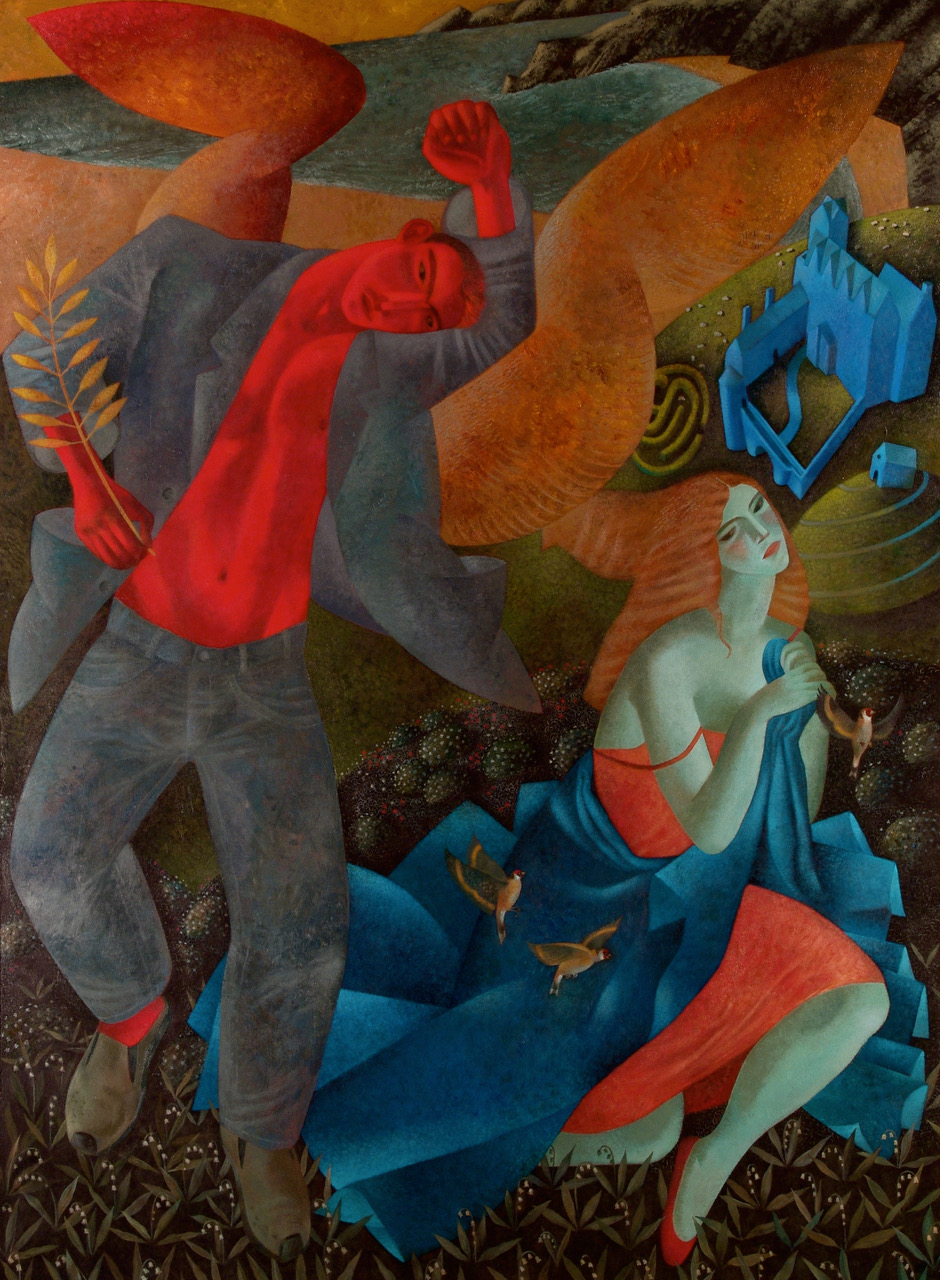
The Virgin of the Goldfinches. Collection of Llandaff Cathedral, Cardiff.

Kevin and the Blackbird